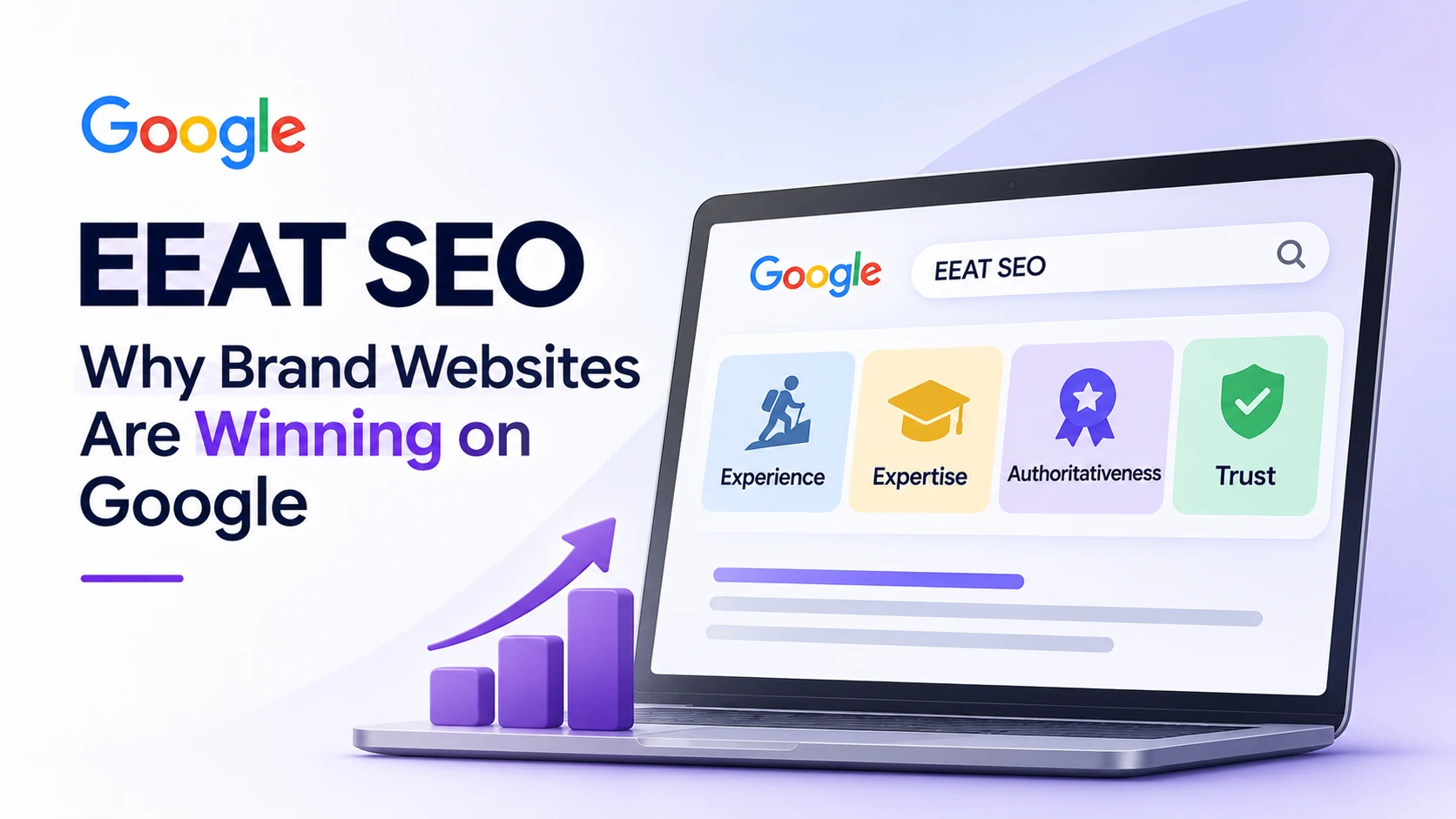
EEAT SEO means building your website so Google can see real Experience, Expertise, Authoritativeness and Trust behind your content. EEAT is not a single ranking factor, but it describes what Google's systems try to reward. In 2026, core updates pushed visibility towards first-party brand websites and away from aggregators, which makes EEAT more practical than ever.
If you run a college, clinic, agency or local business, this is good news. You are the real source. You just need to show it.
- What EEAT means, in simple words
- Why brand websites are beating aggregators in 2026
- The EEAT signals Google can actually see
- A checklist to improve EEAT this month
What Is EEAT in SEO?
EEAT stands for Experience, Expertise, Authoritativeness and Trust. It comes from Google's Search Quality Rater Guidelines, which human raters use to judge page quality. Raters don't set rankings directly, but their feedback helps Google improve its systems. Of the four, trust matters most.
Google's guidelines are clear on this: “Trust is the most important member of the E-E-A-T family,” as quoted by Living Proof Creative. A page can look expert, but if it isn't accurate, honest and safe, it fails.
| Letter | Means | Example |
|---|---|---|
| Experience | You've done it yourself | A trainer sharing real student results |
| Expertise | You know the subject deeply | Certified professional explaining a process |
| Authoritativeness | Others recognise you | Mentions, reviews, partnerships |
| Trust | You're accurate and honest | Clear contact details, sources, policies |
Why Are Brand Websites Beating Aggregators in 2026?
Brand websites are winning because Google's 2026 core updates favoured the real source of information over sites that only summarise others. A college's own course page, a clinic's own treatment page or a brand's own product page now often outranks “top 10” lists and directories built on someone else's facts.
An Amsive analysis of more than 2,000 domains, led by Lily Ray, found aggregators and user-generated content platforms lost US visibility after the March 2026 core update, while first-party brand and government sites gained, as reported by Search Engine Journal.
This links straight to EEAT:
- Experience: the brand actually delivers the service.
- Expertise: its people know the details.
- Trust: it is accountable for what it publishes.
For the full picture of what changed this year, read our guide to the Google core update 2026.
What EEAT Signals Can Google Actually See?
Google can see EEAT through visible proof on your pages and across the web: named authors with credentials, first-hand examples, accurate sources, clear business details, reviews and mentions from other sites. Trust is judged by what you say about yourself, what others say about you and what each page shows.
On your page
- Author name, photo and credentials
- First-hand examples, photos, results and case studies
- Sources for statistics and claims
- A visible “Last Updated” date
On your site
- A detailed About page with real people
- Contact details, address and map
- Clear policies: privacy, refunds, terms
Across the web
- Google Business Profile reviews
- Mentions in news, directories and partner sites
- Consistent name, address and phone everywhere
Google's guide to creating helpful, reliable, people-first content asks a simple question: who created the content, how, and why. Your pages should answer all three.
Extra care for YMYL topics
“Your Money or Your Life” topics, like health, finance and education decisions, face higher trust standards, according to Search Engine Land's E-E-A-T guide. Clinics, financial advisors and colleges should be especially careful with claims.
An EEAT Checklist You Can Apply This Month
The fastest EEAT wins come from adding proof to pages you already have: author boxes, real examples, sources, updated dates and a stronger About page. You don't need to rebuild your site. Start with the ten pages that bring the most traffic or leads and work through the checklist below.
| Task | Time needed | Impact |
|---|---|---|
| Add author box with credentials to every post | 1 day | High |
| Add 1 to 2 first-hand examples per key page | 1 week | High |
| Cite sources for every statistic | 2 days | Medium |
| Rebuild About page with team photos and history | 2 days | High |
| Add visible “Last Updated” dates | 1 hour | Medium |
| Ask 10 happy customers for Google reviews | 1 week | High |
EEAT also powers AI search
The same signals help AI tools trust and cite you. Pair this checklist with a GEO strategy and our steps to get cited in AI Overviews.
Frequently Asked Questions
What does EEAT stand for in SEO?
EEAT stands for Experience, Expertise, Authoritativeness and Trust. It comes from Google's Search Quality Rater Guidelines and describes the qualities Google wants to see in helpful, reliable content. Trust is the most important part.
Is EEAT a Google ranking factor?
Not directly. EEAT is not a single score or switch. It describes what Google's ranking systems try to reward. Pages that show real experience, expertise and trust tend to perform better, especially after core updates.
What are EEAT signals?
EEAT signals are visible proof of credibility. Examples include named authors with credentials, first-hand examples, cited sources, clear contact details, reviews, mentions on other trusted sites and up-to-date information.
How can a small business improve EEAT?
Start with your top pages. Add an author box, real examples from your work, photos, sources for statistics and a visible updated date. Build a detailed About page and collect Google reviews from real customers.
Why does trust matter most in EEAT?
Google's guidelines say trust is the most important part because an untrustworthy page has low EEAT no matter how expert it looks. Accuracy, honesty and safety come first. Experience, expertise and authority all support trust.
Conclusion
EEAT SEO is how real businesses win against aggregators. Show who you are, what you've done and why people can trust you, on every important page. Start with author boxes, real examples and an honest About page. Those same signals help you rank in Google and get cited by AI.
Learn trust-first SEO hands-on
Build SEO that shows real proof.
ETMark Academy's Digital Marketing Implementation Program teaches SEO, EEAT, AEO, GEO and practical content optimisation through live projects.
Sources
- Google Search Quality Rater Guidelines, as quoted by Living Proof Creative
- Google Search Central — “Creating helpful, reliable, people-first content”
- Search Engine Land — “An SEO guide to understanding E-E-A-T”
- Search Engine Journal — “Google Core Update Reshuffles Winners, AI Search Expands Links,” 2026
- Ubersuggest keyword data for India, November 2026