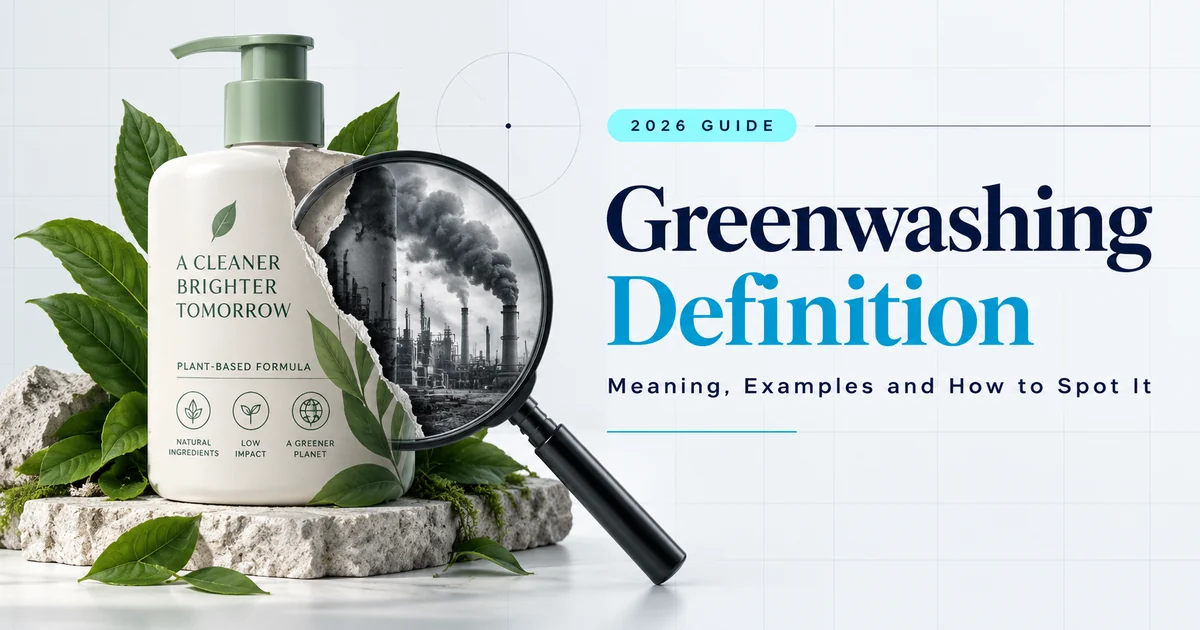
Greenwashing definition: Greenwashing is when a company makes its products, services or business look more environmentally friendly than they really are. It does this through false, vague, exaggerated or incomplete claims, or by hiding information that would change how customers see it. The goal is to win “green” customers without doing the real work.
The problem is bigger than most people think. A study by the Advertising Standards Council of India found that 79% of green claims made by organisations were exaggerated or misleading. A YouGov survey found that 71% of Indian consumers had come across greenwashing, and only 29% trusted companies' environmental claims.
In this guide, you’ll learn:
- The greenwashing meaning in simple words, and where the term came from
- How Indian law now defines greenwashing
- The seven common types of greenwashing
- Real examples from formal regulator and court cases
- How consumers can spot it and how marketers can avoid it
Greenwashing Meaning in Simple Words
Greenwashing means pretending to be green. A company spends more effort on looking environmentally responsible than on actually being responsible. It might call a product “eco-friendly” with no proof, highlight one small green feature while hiding a bigger harm, or use green colours, leaves and nature images to suggest benefits that do not exist.
The word combines “green,” meaning environmentally friendly, and “whitewashing,” meaning covering up something bad. Environmentalist Jay Westerveld is widely credited with coining it in 1986 after noticing hotels asking guests to reuse towels “to save the environment” while doing little else to reduce their impact.
How Indian Regulators Define Greenwashing
In India, the Central Consumer Protection Authority defines greenwashing as any deceptive or misleading practice that conceals, omits or hides relevant information, or makes vague, false, exaggerated or unsubstantiated environmental claims. This definition comes from the CCPA's Guidelines for Prevention and Regulation of Greenwashing or Misleading Environmental Claims, 2024.
India's markets regulator also uses a greenwashing definition in its framework for green debt securities. Separately, ASCI has guidelines for advertisements making environmental claims.
The 7 Types of Greenwashing
The most widely used framework for types of greenwashing is the “Seven Sins of Greenwashing” from TerraChoice. The seven sins are hidden trade-off, no proof, vagueness, irrelevance, lesser of two evils, fibbing and worshipping false labels. In practice, many greenwashing claims combine several of these at once.
| Type | What it means | Example pattern |
|---|---|---|
| Hidden trade-off | Highlighting one green feature while hiding bigger harms | “Made with recycled paper” while ignoring a high-pollution production process |
| No proof | A claim with no evidence anyone can check | “50% less carbon” with no source or test data |
| Vagueness | Words too broad to mean anything specific | “All natural,” “eco-friendly,” “green” |
| Irrelevance | Claiming something true but meaningless | “CFC-free” when CFCs are already banned |
| Lesser of two evils | Making a harmful category sound green | “Organic” cigarettes or “fuel-efficient” SUVs |
| Fibbing | A claim that is simply false | Claiming a certification the product does not have |
| False labels | Fake badges designed to look independent | A self-made “certified green” seal with leaves |
Vague words plus nature imagery plus no proof is one of the easiest patterns for consumers to spot.
Examples of Greenwashing: Real Cases
The clearest examples of greenwashing come from cases where courts or regulators formally ruled against a company. Volkswagen's “Clean Diesel” advertising and KLM's “Fly Responsibly” campaign show how a large gap between environmental messaging and actual impact can create legal, financial and reputational consequences.
1. Volkswagen “Clean Diesel”
From late 2008 to late 2015, Volkswagen USA promoted diesel cars as “Clean Diesel.” In September 2015, the US Environmental Protection Agency issued a notice of violation alleging that certain vehicles used software to cheat emissions tests. In 2016, the US Federal Trade Commission sued Volkswagen for deceptive advertising.
2. KLM “Fly Responsibly”
KLM ran a “Fly Responsibly” campaign with claims about sustainability and carbon reduction. On 20 March 2024, the District Court of Amsterdam ruled that 15 of the 19 challenged statements were misleading and unlawful. The court found that the campaign painted an overly positive picture of the environmental effect of flying.
Patterns seen in India
ASCI's finding that many green claims were misleading shows that the problem is common in India too. Frequent patterns include vague “eco-friendly” or “natural” labels without proof, biodegradable or compostable claims without certification or local disposal context, and green packaging that suggests environmental benefits the product does not deliver.
Greenwashing vs Green Marketing
Green marketing promotes real environmental benefits that a company can prove. Greenwashing promotes environmental benefits that are false, exaggerated, vague or incomplete. The difference is not in the colour palette or imagery. It is whether the claim is specific, accurate and supported by evidence.
| Factor | Green marketing | Greenwashing |
|---|---|---|
| Claims | Specific and measurable | Vague or exaggerated |
| Proof | Data, certifications and audits | None, or selective data |
| Scope | Considers the full product life cycle | Highlights one feature and hides the rest |
| Language | “Bottle made with 30% recycled plastic” | “Eco-friendly bottle” |
| Imagery | Supports a real claim | Replaces a real claim |
| Result | Builds long-term trust | Builds risk of complaints and penalties |
Green marketing is a legitimate field when the environmental benefit is real. Greenwashing is the shortcut that eventually costs more than it saves.
How to Spot Greenwashing as a Consumer
You can spot greenwashing by asking four questions: Is the claim specific? Is there proof? Does it cover the whole product or only one part? Is the label a real, independent certification? If a product relies on green colours, leaves and vague words without clear answers, treat the claim with caution.
Red flags
- Vague words: “eco-friendly,” “natural,” “green” or “conscious” with no explanation.
- No numbers: a real claim usually says how much, and compared with what.
- Nature imagery doing the talking: leaves, earth and green packaging in place of facts.
- Unknown badges: seals that cannot be traced to an independent body.
- Future promises only: distant net-zero claims with no plan or current progress.
What stronger claims look like
- Specific wording and measurable scope.
- Evidence that can be checked.
- Independent, current certifications where relevant.
- Clear explanation of which part of the product the claim refers to.
- Visuals that support, rather than replace, the facts.
If you want to understand why these visual and verbal cues affect perception in the first place, see our guide to neuromarketing and consumer behavior.
How Marketers Can Avoid Greenwashing
Marketers avoid greenwashing by making claims that are specific, true, proven and complete. Replace broad words with exact facts, keep evidence ready before publishing, use genuine certifications, consider the full product life cycle and never let imagery promise more than the product delivers. When in doubt, say less and prove more.
- Is the claim specific, such as “30% recycled plastic” rather than “eco-friendly”?
- Do we have documented proof that we can share if asked?
- Does the claim cover the full product, or clearly say which part it refers to?
- Is any certification genuine, independent and current?
- Do the visuals match the claim without implying extra benefits?
- Have we checked the claim against CCPA and ASCI guidance?
- Would the claim still look honest if a journalist investigated it?
This is part of what we teach at ETMark Academy. Our four-month Digital Marketing Implementation Program in Mysore covers marketing frameworks, copywriting, advertising, campaign execution and platform policies so students learn to write persuasive claims without misleading people. The program is available online and offline.
Frequently Asked Questions
What is the definition of greenwashing?
Greenwashing is when a company makes its products, services or operations look more environmentally friendly than they really are. It uses false, vague, exaggerated or incomplete claims, or hides important information. In India, the CCPA's 2024 guidelines define it as deceptive or misleading practices around environmental claims, including concealing relevant information.
What is the meaning of greenwashing in simple words?
In simple words, greenwashing means pretending to be eco-friendly. A brand uses green words, labels or images to look responsible without making real changes. The term mixes “green” and “whitewashing,” and environmentalist Jay Westerveld is credited with coining it in 1986 after noticing hotel towel-reuse signs.
What are some examples of greenwashing?
Well-known examples of greenwashing include Volkswagen's “Clean Diesel” ads, which the US FTC sued over in 2016 after an emissions-cheating scandal, and KLM's “Fly Responsibly” campaign, where a Dutch court ruled 15 of 19 challenged claims misleading in 2024. Everyday examples include “eco-friendly” or “natural” labels with no proof.
Is greenwashing illegal in India?
Misleading environmental claims can break Indian law. The CCPA's Guidelines for Prevention and Regulation of Greenwashing or Misleading Environmental Claims, 2024 were issued under the Consumer Protection Act, 2019. They require environmental claims to be accurate, evidence-based and clearly disclosed. ASCI also has separate self-regulatory guidelines for green claims in advertising.
What is the difference between greenwashing and green marketing?
Green marketing promotes real, provable environmental benefits using specific claims and evidence. Greenwashing promotes benefits that are false, vague, exaggerated or incomplete. For example, “bottle made with 30% recycled plastic” is green marketing if true, while “eco-friendly bottle” with no explanation is a classic greenwashing pattern.
How can you identify greenwashing?
Check whether the claim is specific, whether proof is available, whether it covers the whole product and whether any certification is real and independent. Be cautious with vague words like “natural” or “eco-friendly,” heavy use of green imagery, unknown badges and distant promises such as “net zero by 2050” with no current plan.
Key Takeaways
- Greenwashing definition: making a product or company look greener than it is through false, vague or incomplete claims.
- India now defines it in regulation: the CCPA's 2024 guidelines set expectations for environmental claims.
- It is widespread: ASCI research has found a high share of green claims studied were exaggerated or misleading.
- Courts and regulators are acting: Volkswagen and KLM show the legal and reputational cost of misleading green claims.
- The fix is simple: be specific, keep proof and never let imagery promise more than the product delivers.
Conclusion
Greenwashing is not just an ethics issue. It is a legal risk, a trust risk and a brand risk, in India and worldwide. Consumers are getting better at spotting it, and regulators have clearer rules for environmental claims.
For marketers, the opportunity is in the opposite direction. Brands that make specific, honest and proven green claims stand out precisely because so many others do not.
Your next step
Learn to write persuasive marketing without misleading people.
Explore ETMark Academy's four-month Digital Marketing Implementation Program, available online and offline, with practical copywriting, advertising and live campaign work.