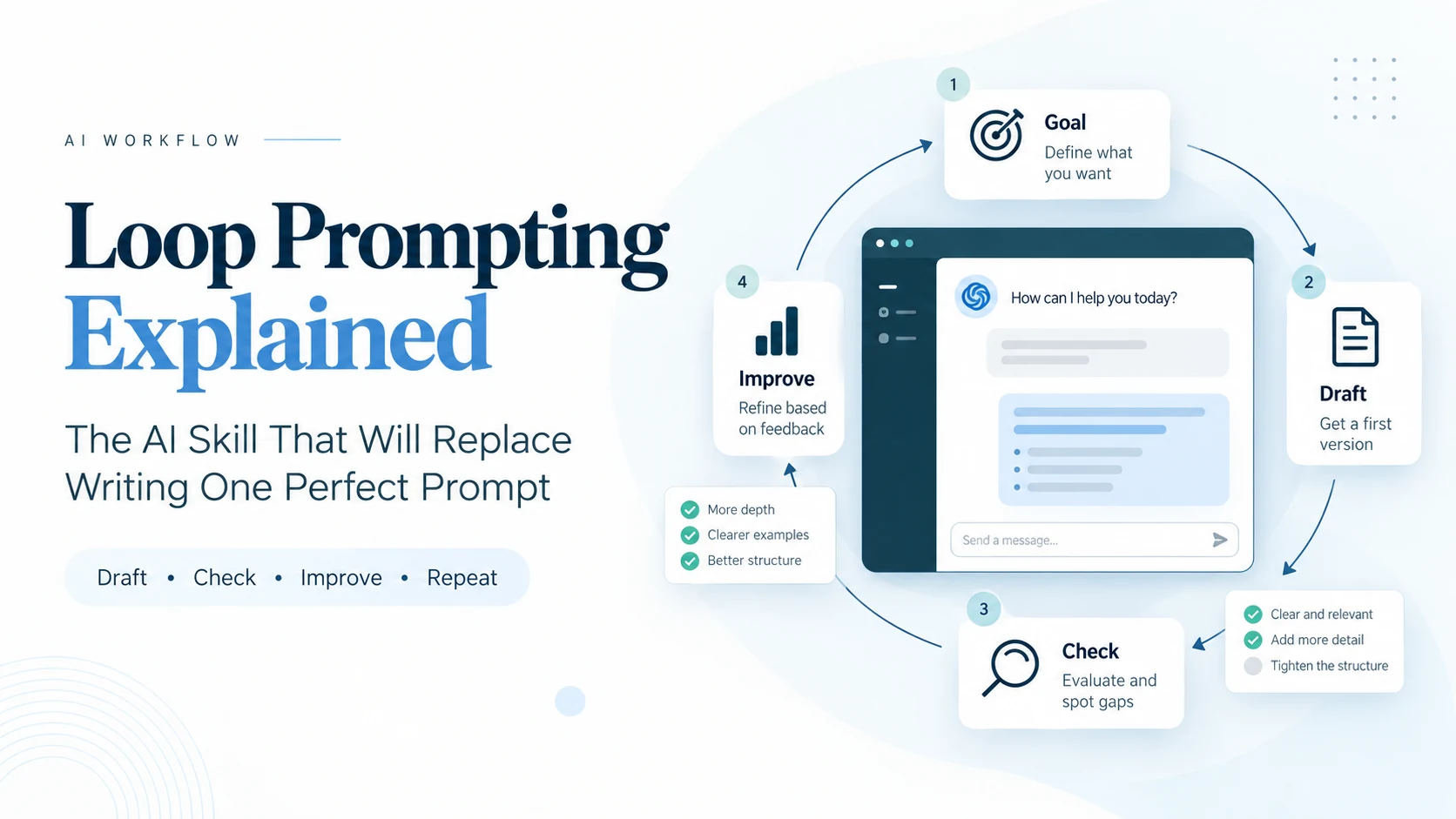
Loop prompting is a way of working with AI where you do not stop at one prompt and one answer. You set a goal, let the AI produce a draft, check it against clear rules, feed the feedback back in, and repeat until the result meets the standard. The prompt becomes a cycle, not a single shot.
For the last few years, people treated AI like a vending machine: type the “perfect prompt”, get the perfect answer. In 2026, a different idea is taking hold: stop trying to write one perfect prompt and start designing the loop that gets you to a great result.
This guide explains what loop prompting is, why it is replacing the one-perfect-prompt habit, how a prompt loop works step by step, and how students and marketers can start using it today.
What Is Loop Prompting?
Loop prompting means running an AI task as a repeating cycle of draft, check and improve, instead of a single request. Each round uses feedback from the last one, and the loop stops when the output meets a defined goal. A prompt loop can be run manually or set up so the AI keeps going on its own.
The idea grew out of a wider 2026 movement called loop engineering. Developer Peter Steinberger argued that teams should stop thinking only about prompting coding agents and start designing the loops that prompt them. Engineering leader Addy Osmani described the same shift as defining a goal that the AI keeps working toward until completion (NextAgile; arXiv, 2026).
| Single prompt | Prompt loop | |
|---|---|---|
| How it runs | Ask once, accept the answer | Draft, check, improve, repeat |
| Who checks quality | You, at the end, if at all | A clear rule checked every round |
| When it stops | After one reply | When the goal is met |
| What you design | The words of one prompt | The goal, the checks and the stopping point |
| Best for | Quick, simple answers | Work that must meet a standard |
Search interest followed the debate. According to the supplied Ubersuggest data, searches for “loop prompting” went from zero to about 1,300 a month worldwide in July 2026.
Why One Perfect Prompt Is No Longer Enough
One perfect prompt is no longer enough because AI rarely gives its best answer on the first try, and research shows that review-and-rewrite cycles can improve results. The skill shifts from polishing one instruction to designing the review cycle around the work.
Researchers from Carnegie Mellon University and the Allen Institute for AI tested a method called Self-Refine, where the same AI writes a draft, gives feedback on it and rewrites it. Across seven tasks, the looped outputs beat one-step answers by about 20% on average (Madaan et al., NeurIPS 2023).
| Date | What happened |
|---|---|
| Jun 2026 | The term “loop engineering” takes off after posts by Peter Steinberger, Boris Cherny and Addy Osmani. |
| May 2026 | Claude Code and other tools add goal-style workflows with completion conditions. |
| Apr 2026 | OpenAI's Codex introduces goals with machine-checkable completion conditions. |
| Mar 2026 | Claude Code adds a recurring loop workflow. |
| Jul 2025 | Geoffrey Huntley publishes the “Ralph Wiggum” technique: feeding the same prompt to an AI coding agent repeatedly. |
Prompt writing still matters. The supplied research notes explicitly argue that loop engineering does not retire prompt engineering. A useful loop still needs good prompts inside it.
How Loop Prompting Works: 5 Steps
A prompt loop has five parts: a clear goal, a first draft, a check against rules, feedback that goes back in, and a stopping point. You can run all five inside a normal ChatGPT, Gemini or Claude chat without coding.
- Set the goal and the rules. Say what “done” looks like before you start. Example: an Instagram caption under 150 words, one clear call to action, no jargon, written for parents of school students.
- Get the first draft. Ask the AI for a version. Treat it as a starting point, not the final answer.
- Check it against the rules. Ask the AI to score its own draft against each rule and list what fails, or check it yourself.
- Feed the feedback back in. Ask for a new version that fixes only the failed points. This is the loop.
- Stop at the finish line. End when every rule passes, or after a set number of rounds. Three is a practical default in the source article.
The most important step is the check. The source article stresses that the checker should be designed first. Without clear rules, the AI can simply rewrite in circles.
Types of Prompt Loops
There are four common types of prompt loops: self-review loops inside a chat, human-in-the-loop prompting, goal loops that run until a condition is met, and scheduled loops that repeat on a timer. Beginners usually start with the first two.
| Type of loop | How it works | Example | Skill level |
|---|---|---|---|
| Self-review loop | The AI drafts, critiques and rewrites its own work | A caption improved over 3 rounds | Beginner |
| Human in the loop | The AI drafts, a person approves or corrects at checkpoints | You approve each ad variant before it goes live | Beginner |
| Goal loop | An AI agent keeps working until a checkable goal is met | A coding agent fixes a website until tests pass | Intermediate |
| Scheduled loop | The same prompt runs again on a timer | A daily check of competitor prices | Intermediate |
The underlying idea is simple: the agent acts, looks at the result, decides what to do next and repeats until the goal is met (NoCode MBA).
Loop Prompting Examples for Students and Marketers
Loop prompting works best on tasks with a clear standard: ad copy that must fit a limit, a resume that must match a job description, or a blog draft that must answer specific questions.
1. Ad copy loop
- Goal: three Meta ad headlines under 40 characters, each with a benefit and a number.
- Check: length, benefit and number.
- Loop: rewrite any headline that fails, up to three rounds.
2. Resume loop
- Goal: a resume summary that matches a specific job description.
- Check: mark which job skills the summary shows.
- Loop: improve missing skills honestly, without inventing experience.
3. Blog draft loop
- Goal: a 600-word explainer that answers five reader questions.
- Check: direct answers, plain language and missing context.
- Loop: simplify and fix gaps until every check passes.
4. Interview practice loop
- Goal: a strong “Tell me about yourself” answer.
- Check: clarity, relevance and confidence.
- Loop: improve the weakest score each round.
Loop thinking also fits naturally with other AI-first workflows. If you are exploring this area, see ETMark's guides on vibe coding in Mysore, synthetic personas and machine customers.
Human in the Loop Prompting: Where You Stay in Control
Human in the loop prompting means the AI runs the draft-check-improve cycle, but a person reviews and approves at key checkpoints. It combines the speed of AI with human judgement on the things AI can get wrong: facts, tone, brand fit and anything with real-world consequences.
- Before the loop starts. You set the goal and the rules. A weak brief creates a weak loop.
- At the checkpoint. You approve or correct the draft before the next round, especially for facts, prices and claims.
- Before anything goes public. A person signs off on ads, client emails and posts.
This is a core practical skill for students and freshers. AI can run many rounds of work on its own, but someone still has to define “good”, judge the result and take responsibility for it.
Common Loop Prompting Mistakes
The biggest loop prompting mistakes are vague goals, no clear check, endless rounds and trusting the AI to mark its own homework. Loops can make good work better, but they can also make wrong work look more confident.
- No clear finish line. If you never define “done”, the AI keeps rewriting without improving.
- Letting AI judge facts alone. Research has found that models can struggle to correct their own reasoning without outside feedback (Huang et al., 2023). Check facts, numbers and claims yourself.
- Gaming the check. If the rule is only “under 150 words”, the AI may satisfy the metric by cutting what matters.
- Too many rounds. After a few rounds, gains can shrink. Set a limit.
- Skipping the human checkpoint. Anything public, legal, medical or financial needs a person's review.
Frequently Asked Questions
What is loop prompting in simple words?
Loop prompting means asking AI to draft, check and improve its work in repeated rounds until it meets a clear goal, instead of accepting the first answer. You define what “good” looks like, and the loop keeps refining until the output passes those rules or reaches a set number of rounds.
What is a prompt loop?
A prompt loop is the repeating cycle itself: a goal, a draft, a check against rules, feedback, and a new draft. It can run inside a normal chat, with you feeding feedback back in, or inside AI agent tools that repeat the cycle automatically until a condition is met.
Is loop prompting the same as prompt chaining?
Not exactly. Prompt chaining links different prompts in a fixed sequence, where each step does a different job. Loop prompting repeats the same draft-check-improve cycle on one task until it meets a standard. Many real workflows combine both.
What is human in the loop prompting?
Human in the loop prompting is a prompt loop where a person reviews and approves the AI work at key checkpoints. The AI handles drafting and revising, while the human sets the goal, checks facts and tone, and signs off before anything is published or sent.
Can I do loop prompting in ChatGPT or Claude?
Yes. In any chat assistant, you can ask the AI to draft, review against your rules and rewrite several times. Agent tools go further by letting the AI repeat work toward a goal with less manual intervention.
Will loop prompting replace prompt engineering?
No. Loop prompting builds on prompt engineering rather than replacing it. Every loop still needs a clear goal, good instructions and sensible checks. What changes is the focus: from writing one perfect prompt to designing a process that reliably reaches a good result.
The Bottom Line
The era of hunting for one magic prompt is ending. People who get strong results from AI increasingly think in loops: set a clear goal, define what good looks like, let the AI improve its work in rounds, and step in at the moments that matter.
Loop prompting does not replace prompt engineering. It gives prompt engineering a process around it, so the output can be checked and improved instead of accepted on the first try.
Build practical AI workflows
Learn to use AI as a process, not a one-shot answer machine.
ETMark Academy's Digital Marketing Course in Mysore teaches practical AI workflows for content, ads and campaigns alongside SEO, Meta Ads and Google Ads.