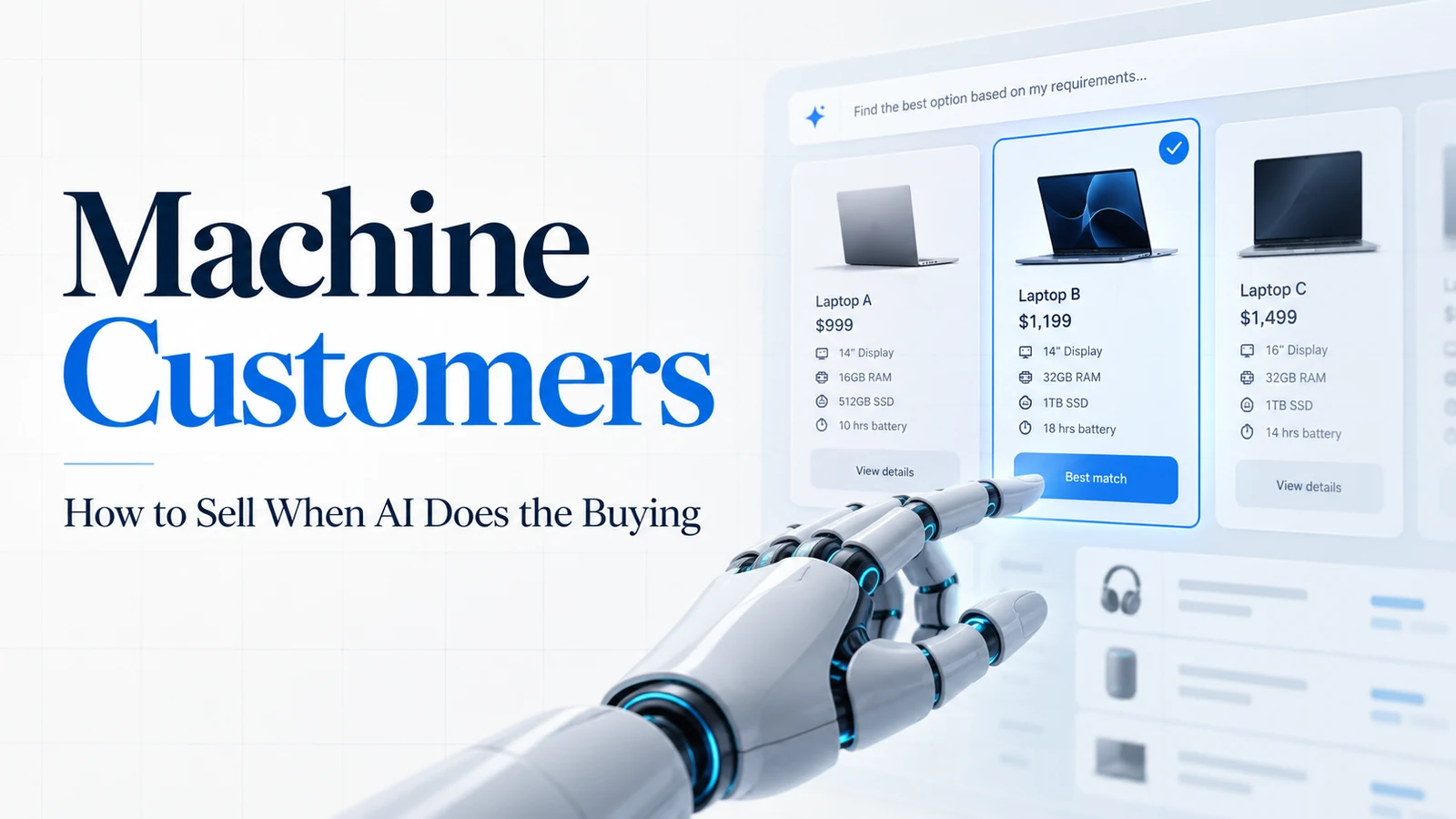
Machine customers are AI agents that research, compare and buy products on behalf of a person or a business. Instead of a human scrolling your website, a piece of software reads your data, checks your price and decides whether you make the shortlist.
For decades, marketing has been built on one assumption: the buyer is a human with emotions, habits and a short attention span. That assumption is starting to crack. A growing share of shopping journeys now begin with someone telling an AI assistant what they need and letting it do the legwork.
This guide explains what machine customers are, what the research firms predict, how they buy differently from people, and what marketers should learn now to stay relevant.
What Are Machine Customers?
A machine customer is a non-human buyer: an AI agent or connected device that finds, evaluates and purchases goods or services with little or no human input. Research firm Gartner popularised the term to describe AI assistants and automated systems that act as customers (Gartner).
This shift has a name in marketing circles: Business-to-Agent, or B2A. You already know B2B and B2C. B2A is selling to software that represents a human.
Why Machine Customers Matter Now
Machine customers matter because the biggest research firms expect AI agents to start a large share of buying journeys within the next few years. Early data already shows AI-referred shopping growing fast, even though fully automatic buying is still rare.
| Source | Prediction or finding |
|---|---|
| Gartner, cited by Improvado | By 2027, 50% of people in advanced economies will have AI assistants capable of making purchases. |
| IBM iX | By 2027, three quarters of digital engagements will begin inside agent environments, not on a brand's website. |
| Forrester, cited by CX Foundation | At least three major brands will see single-day call spikes 100 times above normal by end of 2026, caused by customers' AI agents. |
| Webtonic, citing Shopify | Shopify's AI-referred orders grew nearly 13x year over year in Q1 2026. |
There is a balancing view too. Gartner also predicts that by 2030, under 10% of e-commerce revenue will come from consumer AI shopping tools, because many people still do not trust them.
The honest picture: machine customers will influence what people buy long before they do the buying themselves. If an AI assistant never mentions your brand, you lose the sale before a human ever sees you.
How Machine Customers Buy Differently from People
Machine customers buy on facts, not feelings. They read structured data, compare prices and specifications instantly, and ignore slogans, colours and emotional stories that work on human buyers.
| What matters | Human customer | Machine customer |
|---|---|---|
| How they find you | Search, social, ads, word of mouth | AI answers, product feeds, APIs |
| What persuades them | Stories, emotion, brand image | Price, specs, reviews, availability |
| How they read your website | Visually, skimming | As data, reading every field |
| Loyalty | Habit and brand love | Whatever best fits the rules they were given |
| Response to ads | Can be influenced | Mostly filters ads out |
Forrester puts it plainly: AI agents do not browse websites or respond to marketing narratives in the same way people do. They retrieve and validate structured information.
One more twist. An agent's “preferences” are really the settings its owner gave it. So brand building still matters, because humans decide which brands their agent should favour.
How to Market to Machine Customers: 5 Steps
To market to machine customers, make your business easy for AI to read, trust and recommend. That means clean product data, structured markup, consistent facts across the web, strong reviews, and a check of what AI assistants currently say about you.
- Audit what AI says about you. Ask ChatGPT, Gemini and Perplexity to recommend a business like yours. Note whether you appear, and whether your prices, hours and services are correct.
- Add structured data. Use schema markup (JSON-LD) so an agent knows exactly what product, price and availability a page shows. This is one of the most practical ways to improve how agents read your site.
- Keep facts identical everywhere. Your website, Google Business Profile, marketplaces and directories should all show the same price, address and details. Agents distrust conflicting data.
- Earn reviews and third-party mentions. Agents lean on signals of trust. Reviews, press mentions and comparison listings help you make the shortlist.
- Clean up product feeds. If you sell online, a complete Google Merchant Center or marketplace feed is now a marketing asset, not just an operations task.
None of this replaces marketing to humans. It adds a second audience you cannot afford to ignore.
Skills Marketers Need for the Machine Customer Era
Marketers preparing for machine customers need a mix of classic skills and new technical ones: structured data, AI search visibility, product feed management and analytics. Students who learn these now will be ahead of most working marketers.
| Skill | Why it matters for machine customers |
|---|---|
| Schema markup and technical SEO | Lets AI agents read your pages as clean data. |
| GEO and AI search visibility | Gets your brand mentioned in AI answers. |
| Product feed management | Feeds power shopping agents and AI shopping results. |
| Analytics and conversion tracking | Shows which traffic comes from AI tools. |
| Brand building and content | Humans still decide which brands their agents trust. |
The good news for students: these are learnable, practical skills. You do not need to be a programmer. You need to understand how machines read the web and how to shape what they find.
Frequently Asked Questions
What is a machine customer?
A machine customer is an AI agent or connected device that researches, compares and buys products or services for a person or business. Examples include AI shopping assistants, automated procurement software and devices that reorder their own supplies. They decide using data such as price, specifications, reviews and availability.
What is B2A marketing?
B2A, or Business-to-Agent, means marketing to AI agents that act on behalf of customers. It sits beside B2B and B2C. Instead of persuading a person, B2A focuses on giving agents accurate, structured and trustworthy information so they include your brand when they shortlist or recommend options.
Will machine customers replace human customers?
No. Humans will still set the goals, budgets and preferences their agents follow. Machine customers change who does the research and comparison. Brands will need to market to both: humans for trust and preference, and agents for accurate data and easy comparison.
How can a small business prepare for machine customers?
Start by checking what AI assistants say about your business. Then add schema markup to your website, keep your details identical across all listings, collect genuine reviews, and keep product information complete. These steps also improve your regular SEO, so the effort pays off today.
Do I need coding skills to market to machine customers?
No. Most of the work involves structured data tools, SEO plugins, product feeds and content. Understanding how AI reads the web matters more than writing code. These skills can be learned in a practical digital marketing course.
The Bottom Line
Your next customer may not have a face, but it will have rules. Brands that make themselves easy for machines to read, verify and recommend will win the shortlist. Brands that only speak to emotions will quietly disappear from AI answers.
Build the skills for what comes next
Learn to market for both human and machine customers.
ETMark Academy's Digital Marketing Course in Mysore covers SEO, GEO, structured data, analytics and AI tools, so you are ready for both human and machine customers.