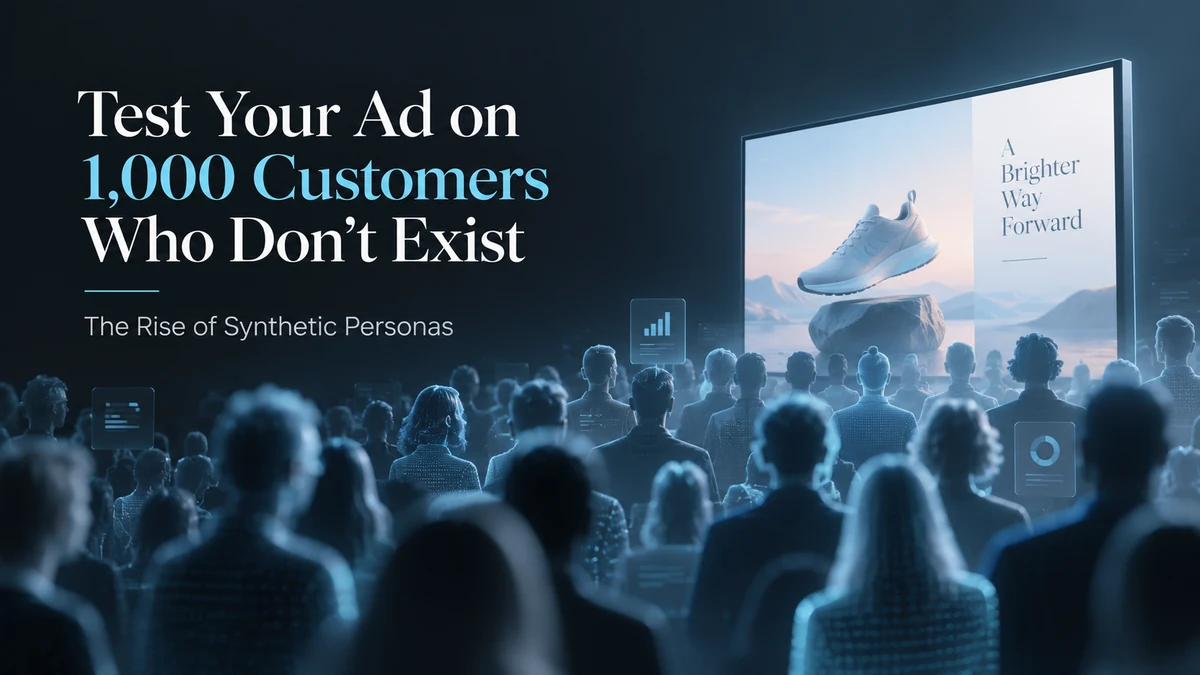
Synthetic personas are AI-generated customer profiles that think, react and answer like real buyers. Brands use them to test ads, messages and offers on thousands of simulated customers before spending money on a live campaign or a survey.
Picture this. You have three ad concepts and one budget. Normally you guess, launch, and wait two weeks to learn which one worked. With synthetic personas, you show all three to 1,000 simulated customers in an afternoon and walk into the launch already knowing which headline lands.
That is why synthetic personas are quietly becoming one of the most talked-about ideas in marketing research. This guide explains what they are, how the testing works, where the evidence stands today, and where the method still falls short.
What Are Synthetic Personas?
A synthetic persona is an AI model set up to answer like a specific type of customer. It is not a slide with a stock photo and a name like “Marketing Meera”. It is a working simulation you can question, show an ad to, and ask “would you buy this, and why?”
Researchers call groups of these simulated people “silicon samples”. The idea rests on a property called algorithmic fidelity: a language model, given the right background, can mirror the attitude patterns of different groups of people (Argyle et al., Political Analysis, 2023).
| Factor | Classic buyer persona | Synthetic persona |
|---|---|---|
| What it is | A written profile in a document | An AI you can question |
| How it is used | Guides the team's thinking | Reacts to ads, offers and messages |
| How many | Usually 3 to 5 | Hundreds or thousands at once |
| Built from | Workshops and assumptions | Real data, interviews, surveys or psychology models |
The quality of a synthetic persona depends almost entirely on what it is built from. A persona grounded in real interviews behaves very differently from a model simply told to “pretend you are a 30-year-old mother in Pune”. That gap shows up clearly in the research below.
How Synthetic Persona Testing Works
Synthetic persona testing runs in four stages: you build a simulated audience from data, show it your ad, collect its reactions, and compare those reactions against real customers. The first answers arrive in minutes instead of weeks.
One research team compared what personas are built from. AI agents created from two-hour interviews with 1,052 real people reproduced those people's survey answers at up to 86% of the consistency humans show with themselves after two weeks. Agents built from demographics alone reached only 74% (Park et al., Stanford, 2024).
The lesson for marketers is simple: your own customer data is the raw material. A generic prompt gives you a generic customer.
Why Marketers Are Paying Attention Now
Marketers are paying attention because synthetic personas now match real customers closely enough for early testing, and they work in hours instead of weeks. Most market researchers expect synthetic responses to become a normal part of research within a few years.
The adoption numbers come from Qualtrics' annual survey of more than 3,000 market researchers across 15 countries, including India. In its 2025 report, 71% agreed that most market research will use synthetic responses within three years, and 69% had already used them in the past year (Research Live, 2024). In the 2026 edition, 45% of researchers who adopted synthetic data called it their most reliable data source (Research Live).
| Study | What was tested | Result |
|---|---|---|
| Maier et al., with PyMC Labs and Colgate-Palmolive, 2025 | Purchase intent across 57 product surveys, about 9,300 real responses | 90% of human test-retest reliability |
| Park et al., Stanford, 2024 | 1,052 people simulated from two-hour interviews | Up to 86% of human retest consistency |
| Yeykelis et al., 2024 | Effects from 133 published experiments | 76% of main effects reproduced (84 of 111) |
Note what these numbers mean. “90% of human test-retest reliability” does not mean 90% correct. It means the AI is almost as consistent as real people are when you ask them the same question twice.
Then there is speed. A classic audience study takes weeks. A synthetic test returns a first structured reaction to an ad or landing page in minutes. For a small brand testing five headlines, that difference decides whether testing happens at all.
Synthetic Personas vs Real Customer Research
Synthetic personas are faster and cheaper, but real customer research is still more reliable for final decisions. The smart approach uses both: synthetic testing to narrow down options, real people to confirm the winner.
| Factor | Synthetic personas | Real customer research |
|---|---|---|
| Time to first results | Minutes to hours | Days to weeks |
| Cost per test | Low | High: panels, incentives, agency fees |
| Number of variants you can test | Dozens | Usually 2 to 4 |
| Follow-up questions | Unlimited, instant | Limited by the session |
| Spread of opinions | Too narrow, often too positive | True variety |
| Niche or rare audiences | Weak | Strong, if you can recruit them |
| Best for | Early screening and pretests | Final validation and big bets |
The research is clear on the weak points. Synthetic respondents can match real averages while showing far less variety than real people. In one study, 48% of the statistical relationships from AI answers differed significantly from human data, and about a third flipped direction (Bisbee et al., Political Analysis, 2024).
In practice: use synthetic personas to cut ten ad ideas down to two. Then let real customers pick the winner.
How to Test Your Ad on Synthetic Personas: 6 Steps
To test an ad on synthetic personas, start with real customer data, build a simulated audience from it, show each ad variant, ask focused questions, rank the results, and confirm the winner with a small live test. The whole cycle can run in a single day.
- Collect your real customer signals. Pull past survey answers, sales call notes, WhatsApp enquiries, Google reviews and comments on your posts. These hold the words, doubts and motivations of real buyers.
- Define two or three segments. For example, “first-time home buyers in tier-2 cities” and “NRI investors”. Keep each segment specific. Broad segments produce bland answers.
- Build the personas. Use a synthetic research platform, or an AI assistant given your customer data and clear instructions to answer as a member of each segment. Create many personas per segment, not one.
- Show every ad variant the same way. Present the headline, visual description, offer and call to action. Ask each persona to rate it, say what stood out, name any doubt, and say whether it would click.
- Look for patterns, not praise. Synthetic personas lean positive, so treat “I like it” as noise. Focus on objections, confusion and which variant wins across segments.
- Validate with a small live test. Run the top one or two variants as a low-budget Meta or Google campaign. If real results agree, scale. If they disagree, trust the real data and update your personas.
A useful rule from the research: personas built on interviews and real records beat personas built on demographics alone (Park et al., 2024). Step 1 is where most of the accuracy comes from.
The Limits: Where Synthetic Personas Get It Wrong
Synthetic personas get it wrong when you treat them as a replacement for real people. They are too polite, too similar to each other, and weak on culture, emotion and small niche audiences. Their biggest danger is false confidence.
Main risks to watch
- Positivity bias: AI respondents tend to like what they are shown. Real customers scroll past.
- Too little variety: Answers cluster around the average, so extreme views and surprising reactions go missing (Bisbee et al., 2024).
- Weak on culture and humour: Models still struggle with cultural nuance, jokes and emotion-driven choices, and some regional differences do not show up reliably (PyMC Labs, 2026).
- Thin data on niche groups: The less a group appears in the AI's training data, the less accurate its personas.
- Bad at change: When markets shift fast, the AI is working from the past.
Use real research instead when
- You are pricing a new category
- You are entering a market you have never sold to
- The topic involves sensitive health or finance claims
- A wrong decision would be too expensive to recover from
- Cultural or regional nuance is central to the campaign
Austrian opinion researcher Christoph Hofinger described the core risk as “false confidence” instead of admitting the method does not know (ORF.at, 2026, via Radical Innovators).
What Synthetic Personas Mean for Indian Brands
For Indian brands, synthetic personas are a cheap way to pre-test ads before spending on Meta and Google, which matters most for small and mid-sized businesses that cannot afford research agencies. The catch is that Indian audiences are diverse, and AI is weakest exactly where India is most varied.
Where they can help today
- Small budgets: A clinic, builder or coaching institute can screen five ad concepts before putting money behind one.
- Festive and launch campaigns: Test messages before Diwali or a project launch, when there is no time for a survey.
- B2B outreach: Simulate how a plant head, HR manager or CFO might react to an email or LinkedIn message.
Where to be careful
- Regional language and culture: A persona reacting to a Kannada or Hinglish ad may miss tone, humour and local references. Always check regional creatives with real people from that region.
- Tier-2 and rural buyers: These groups are under-represented in AI training data, so personas built only on demographics will guess.
- Health, finance and real estate claims: Never let a simulated audience approve a claim that needs legal or regulatory review.
India is already part of this shift. Qualtrics' research on synthetic responses surveyed market researchers in 15 countries, India among them (Research Live, 2024).
Frequently Asked Questions
What is a synthetic persona in marketing?
A synthetic persona is an AI-generated stand-in for a real customer type. It is built from data such as surveys, interviews and profiles, and it can react to ads, offers and messages. Marketers use groups of synthetic personas to test ideas quickly before spending money on live campaigns or traditional research.
Are synthetic personas accurate?
They can be, for the right job. Personas built from real interviews reproduced people's survey answers at up to 86% of human retest consistency in a Stanford study. They are less reliable for niche groups, cultural nuance and representative statistics, so treat them as a screening tool, not proof.
Can synthetic personas replace focus groups and surveys?
No. Synthetic personas are best for narrowing options early. Real customers are still needed for final validation, pricing and high-risk decisions. The most reliable approach is hybrid: synthetic testing first to cut weak ideas, then a small real-customer test or live campaign to confirm the winner.
How much does it cost to test an ad on synthetic personas?
Cost varies widely by platform, from low-cost self-serve tools to enterprise research products. Compared with recruiting a panel or running focus groups, it is usually far cheaper per test. You can also run a simple version with an AI assistant and your own customer data at very low cost.
What data do I need to build synthetic personas?
The best inputs are real customer signals: interview notes, survey responses, sales call notes, reviews, enquiries and CRM data. Demographics alone produce generic personas. The more real customer language you provide, the closer the simulated reactions get to how actual buyers think.
Are synthetic personas useful for small businesses in India?
Yes, for pre-testing ad concepts and messages before spending on Meta or Google. Be careful with regional-language creatives, tier-2 and rural audiences, and regulated claims in health, finance or real estate. Always confirm the winning ad with a small live test before scaling the budget.
The Bottom Line
Synthetic personas will not replace your customers. They will replace guessing. Brands that test ten ideas on simulated buyers before spending on one will waste less budget and learn faster than brands that launch on gut feel.
Start small. Take your next campaign, write three versions of the ad, build a simulated audience from your own customer data, and see which version survives. Then let real customers confirm it.
Learn it hands-on
Build AI-powered marketing skills around real campaigns.
ETMark Academy's Digital Marketing Course in Mysore teaches AI-powered marketing the practical way, including how to pre-test ads, run Meta and Google campaigns, and read real results.