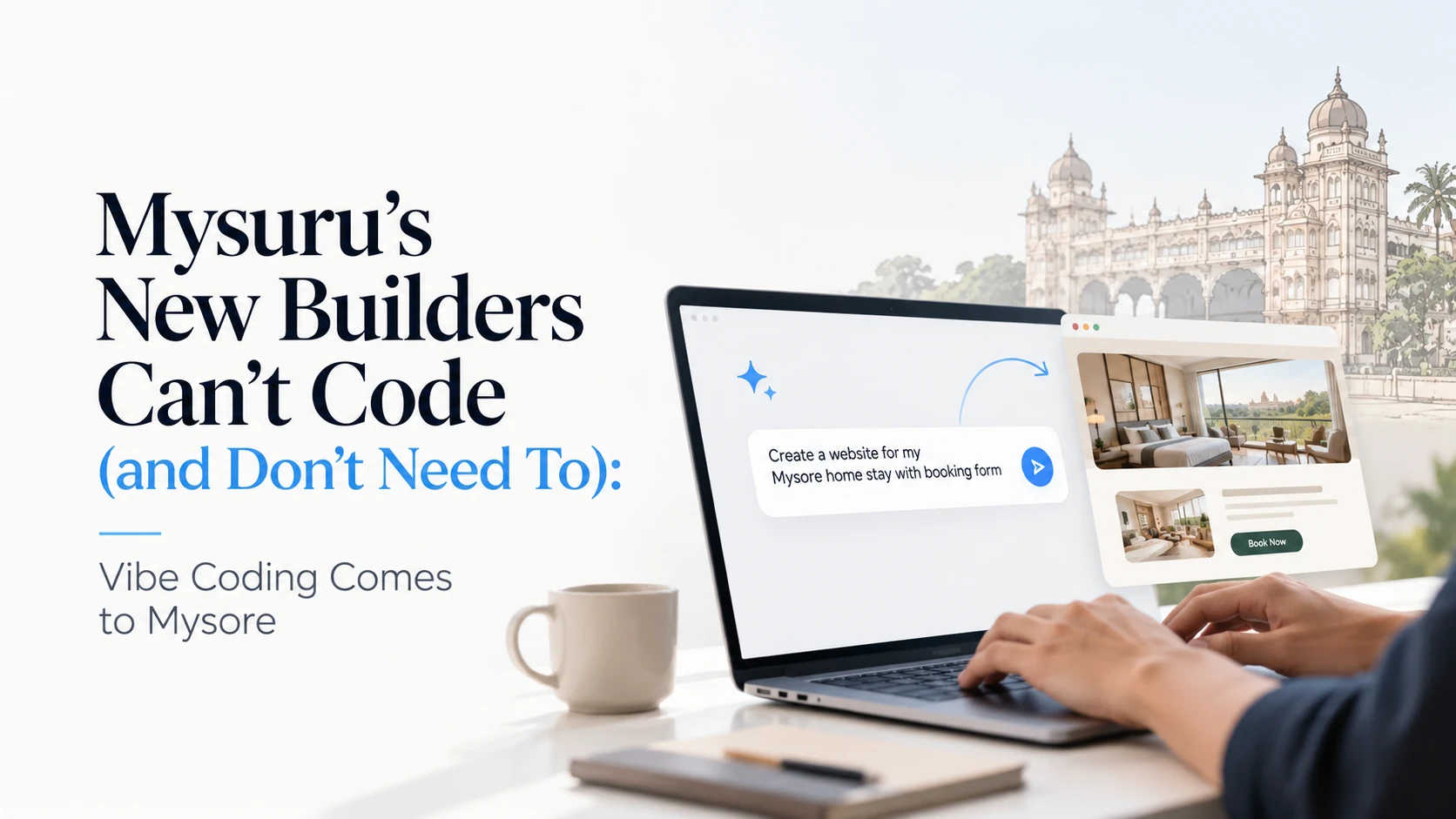
Vibe coding means building apps, websites and tools by describing what you want to an AI in plain language, instead of writing code line by line. In Mysuru, it is opening software building to students, shop owners and founders who never learnt to program.
For most people in Mysore, “building an app” used to mean hiring a developer in Bengaluru or giving up on the idea. Today, a commerce student can describe a fee tracker to an AI tool and have a working version the same evening. A boutique owner can build a booking page without knowing what HTML is.
Interest is already here. People in Mysuru search for “vibe coding” about 260 times a month, and “what is vibe coding” about 90 times a month (Ubersuggest, 2026). This guide explains what vibe coding is, who can use it, what you can build, and how to start in Mysore.
What Is Vibe Coding?
Vibe coding is a way of making software where you describe what you want in everyday language and an AI tool writes the code. You guide, test and give feedback, while the AI does the typing. The term was coined in February 2025 by Andrej Karpathy, a founding engineer at OpenAI (Wikipedia).
The idea spread so fast that Collins Dictionary named “vibe coding” its Word of the Year for 2025. Collins' managing director Alex Beecroft said it signals a shift where AI is “making coding more accessible” (Shropshire Star).
Here is the difference in practice:
| Traditional coding | Vibe coding | |
|---|---|---|
| How you build | Write code line by line | Describe what you want in plain words |
| What you need to know | A programming language | Clear thinking and good instructions |
| Time to a first version | Days to weeks | Minutes to hours |
| Your main job | Writing and debugging | Planning, testing and giving feedback |
Interest in India is huge. “Vibe coding” gets about 60,500 searches a month nationally, and “what is vibe coding” about 22,200 (Ubersuggest, 2026).
Who in Mysuru Can Use Vibe Coding?
Vibe coding suits anyone in Mysuru with an idea and a problem to solve: college students building portfolios, small business owners automating daily work, and founders testing a product before hiring developers. You do not need an engineering degree.
- College students. BCom, BBA and BCA students can build real projects for their portfolio, such as a placement tracker or a college event app, and show recruiters working proof instead of just certificates.
- Shop owners and local businesses. A Devaraja Market trader, a clinic or a silk saree boutique can build a simple order form, stock sheet or appointment page without paying an agency.
- Founders and freelancers. Test a startup idea with a working prototype in a weekend, then decide whether it is worth investing in.
- Teachers and trainers. Build quiz tools, attendance trackers and small learning apps for their own classrooms.
- Working professionals. Automate reports and repetitive spreadsheet tasks at work.
What You Can Build With Vibe Coding
With vibe coding, beginners can build websites, landing pages, simple web apps, calculators, dashboards and small automations. Complex apps with payments, logins and large user bases are possible too, but need more care and testing.
| What you can build | Example for Mysuru | Difficulty for a beginner |
|---|---|---|
| Landing page or website | A homestay booking page | Easy |
| Calculator or quiz | An EMI calculator for a builder's site | Easy |
| Personal portfolio | A student's project showcase | Easy |
| Simple tracker | A tuition fee or attendance tracker | Medium |
| Small dashboard | Daily sales summary for a shop | Medium |
| Booking or order app | Appointments for a clinic or salon | Medium to hard |
| App with payments and logins | A subscription product | Hard, needs expert review |
A good rule: start with something you or someone you know will actually use this week. Real problems make the best first projects.
How to Start Vibe Coding in Mysore: 6 Steps
To start vibe coding, pick one small real problem, write a short plan describing what you want, give that plan to an AI coding tool, test what it builds, and improve it through feedback. You can do your first project in a single weekend.
- Pick one small, real problem. For example, “a page where my tuition students can check their fee status”.
- Write a Project Requirement Document (PRD). A one-page plan: who uses it, what it must do, and what it should look like. This is the most important skill in vibe coding.
- Choose a tool. Beginner-friendly options include AI assistants such as Claude and ChatGPT, and AI app builders and editors such as Lovable, Bolt and Cursor.
- Build in small steps. Ask for one feature at a time. Check it works before asking for the next.
- Test like a user. Click every button, enter wrong data on purpose, and open it on your phone.
- Learn the basics as you go. Understand enough about how the web works to spot mistakes and keep your data safe.
Learning alone works, but a structured cohort with a mentor and real projects can reduce trial and error.
The Limits of Vibe Coding
Vibe coding is excellent for prototypes and small tools, but it is not magic. AI can write code with security holes, bugs it cannot see, and designs that break as the app grows. Anything handling money, health data or many users still needs expert review.
- Security risks. Vibe-coded apps can expose data if nobody checks them. Researchers have already found security flaws in vibe coding platforms (Wikipedia).
- You still own the result. If something breaks, “the AI wrote it” is not an answer a client will accept.
- Hard to maintain. Code you do not understand is hard to fix later.
- Not a shortcut past thinking. A vague instruction gives a vague app. Clear planning matters more than ever.
The smart approach: use vibe coding to build fast, and learn enough fundamentals to check what the AI produces.
Frequently Asked Questions
What is vibe coding in simple words?
Vibe coding is building software by telling an AI what you want in plain language instead of writing code yourself. You describe the app, the AI writes the code, and you test it and ask for changes. The term was coined by Andrej Karpathy in February 2025 and became Collins' Word of the Year.
Can I learn vibe coding without any coding knowledge?
Yes. Vibe coding is designed for people who describe what they want rather than write code. Clear thinking, planning and testing matter most. Learning a few basics about how websites and apps work helps you spot mistakes and build more reliable projects.
Is there a vibe coding course in Mysore?
Yes. ETMark Academy in Mysuru runs a project-based vibe coding programme for students and working professionals, built around real projects. It starts with writing a Project Requirement Document and moves to building, testing and improving apps with AI tools. Contact ETMark Academy for current programme details.
Which tools are best for vibe coding beginners?
Beginners often start with AI assistants such as Claude and ChatGPT, then move to AI app builders and coding editors such as Lovable, Bolt and Cursor. The best tool depends on what you are building. Start simple and switch tools as your projects grow.
Can vibe coding help me get a job?
It can help you stand out. Employers value people who can build working tools quickly, and a portfolio of real projects is stronger proof than a certificate. Combine vibe coding with skills such as digital marketing, data or design for the best results.
The Bottom Line
Mysuru does not need to wait for Bengaluru to build its own software. With vibe coding, the student with a project idea, the shop owner with a daily headache and the founder with a startup dream can all build their first version themselves. The barrier is no longer code. It is clear thinking and the willingness to start.
Start building with AI
Turn an idea into a working first version.
ETMark Academy's vibe coding programme in Mysore is built around practical projects and AI tools. Contact the academy for current programme details, or explore the Digital Marketing Course in Mysore to build a broader AI-powered marketing skill set.