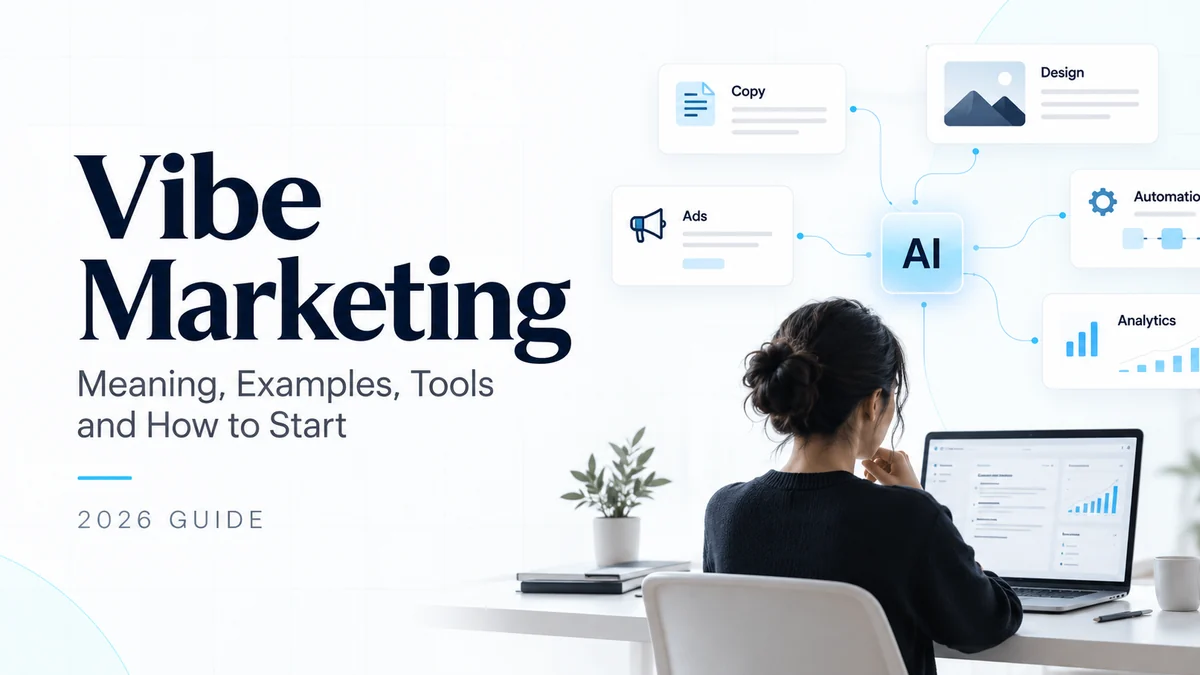
Vibe marketing is a way of doing marketing where you describe the goal, the audience and the feel you want, and AI tools do most of the execution. That includes research, copy, creatives, landing pages, automation and reporting. One marketer sets the direction and checks the output. The AI handles the volume.
The idea is new, and so is the search interest. In India, “vibe marketing” gets about 480 searches a month, and almost every related phrase has close to zero competition (Ubersuggest data, October 2026). Most people searching for it want a plain answer to one question: is this a real skill, or just another buzzword?
In this guide, you’ll learn:
- What vibe marketing means, in plain words
- Where the term came from and why it spread so fast
- How a vibe marketing workflow actually runs
- The tools people use and the risks they skip over
- The skills you need to do it well
What Is Vibe Marketing?
Vibe marketing is AI-led marketing execution directed by a human. You give AI tools the intent, the audience, the tone and the outcome you want. The tools then research, write, design, automate and measure. Your job shifts from doing every task by hand to setting direction, judging quality and deciding what to ship.
The “vibe” in the name means you work from intent, not step-by-step instructions. You say “a warm, festive WhatsApp campaign for repeat customers” instead of writing every line yourself.
Three things define vibe marketing in practice
- Natural-language direction: You brief AI the way you would brief a team member.
- Fast experiments: You test many angles in a day instead of one angle in a week.
- Connected workflows: Automation tools link research, content, ads and reporting so tasks run with less manual work.
You will also see the phrase used loosely for “marketing with a strong brand vibe,” meaning aesthetic, mood-led branding. That is a different idea. This guide covers the AI meaning, which is the one driving the search trend.
Where the Term Vibe Marketing Came From
Vibe marketing grew out of “vibe coding,” a term Andrej Karpathy, a founding engineer at OpenAI, coined in February 2025. He described a new way of coding where you “fully give in to the vibes” and let AI write the code. Marketers soon borrowed the idea and applied it to campaigns, content and automation.
The parent term spread fast. Collins Dictionary named “vibe coding” its Word of the Year for 2025, after tracking a huge rise in usage across its 24-billion-word corpus (CNN, 2025).
On the marketing side, Scott Brinker, editor of chiefmartec, credits entrepreneur Greg Isenberg as the first person to coin “vibe marketing.” Isenberg framed it as AI agents and workflows that let one marketer do work that once needed a team of specialists (chiefmartec, 2025).
Brinker adds an important twist. He argues that vibe marketing “should be about experimentation,” aimed at delighting customers rather than just automating tasks (chiefmartec, 2025). We agree with him. The point is better marketing, not just more of it.
Vibe Marketing vs Traditional Marketing
Traditional marketing runs through specialists and handoffs: a writer, a designer, an ads manager and an analyst, each doing one step. Vibe marketing puts AI tools in the middle, so one person can brief, produce, test and report in a single loop. The skills stay the same. The speed, cost and team size change.
| Factor | Traditional marketing | Vibe marketing |
|---|---|---|
| Who does the work | A team of specialists | One marketer directing AI tools |
| Speed | Days or weeks per campaign | Hours or days per campaign |
| Testing | A few versions at a time | Many angles tested at once |
| Briefing style | Detailed task lists | Intent, audience, tone and outcome |
| Main skill | Doing the task well | Judging and directing the output well |
| Main risk | Slow and expensive | Generic content and unchecked errors |
The shift is already visible in the data. In Social Media Examiner’s 2026 AI Marketing Industry Report, 73% of marketers said they use AI every day. In the same survey, 79% said they either use AI agents or plan to, and “using AI agents” was the top topic marketers wanted to learn, at 74% (Social Media Examiner, 2026).
A Vibe Marketing Workflow, Step by Step
A vibe marketing workflow has five steps: brief the AI on the goal and audience, generate many variations, review them with human judgment, automate the delivery and measure what works. The human stays in charge of the first and third steps. Those two steps decide whether the output helps the brand or hurts it.
Here is how it might look for a sweet shop running a Diwali offer:
At Sugar Salt Media, our sister agency, we already work this way on parts of client work. We use AI to produce product ad creatives, and we built our own AI assistant to help manage Google Ads accounts. The pattern holds every time: AI speeds up production, and human review protects quality.
Vibe Marketing Tools
Vibe marketing tools fall into five groups: AI assistants for thinking and writing, design and video tools for creatives, automation tools for connecting steps, ad platforms with built-in AI, and analytics tools for measuring results. You do not need all of them. Most beginners start with one AI assistant, one design tool and one automation tool.
| Tool category | Examples | What it does in a vibe marketing workflow |
|---|---|---|
| AI assistants | ChatGPT, Claude, Gemini | Research, briefs, copy, scripts, analysis |
| Design and video | Canva, CapCut | Social creatives, ad visuals, short videos |
| Automation | n8n, Make, Zapier | Connect forms, sheets, CRM, email and WhatsApp |
| Ad platforms with built-in AI | Meta Ads, Google Ads | AI-driven targeting, bidding and creative testing |
| Analytics | Google Analytics 4, Microsoft Clarity | Track what each version actually achieved |
Pro tip: Learn one tool from each category well before adding more. A marketer who knows ChatGPT, Canva and n8n deeply will outperform one who has tried twenty tools once.
The Risks Nobody Puts in the Hype Posts
Vibe marketing has four real risks: generic content that sounds like everyone else, factual errors that go out unchecked, brand voice drift across many AI-made pieces, and compliance mistakes such as messaging people without consent. Every one of them comes from skipping human review. None of them is solved by adding more tools.
Common mistakes to avoid
- Shipping first drafts: AI output is a draft. Treat it like work from a new intern.
- Measuring volume, not results: Fifty posts a week means nothing if leads do not grow.
- Ignoring brand voice: Give the AI your tone guide and real examples, or every piece will sound the same.
- Automating without consent: Bulk messages to people who never opted in can get WhatsApp numbers banned and damage trust.
- Skipping the fundamentals: If you do not understand targeting, funnels and tracking, AI only helps you make mistakes faster.
What protects quality
- Clear audience and outcome before prompting
- Human review before anything is published
- Fact, pricing and claim verification
- Brand voice examples inside the brief
- Measurement against business outcomes
The ROI question is still open for many teams. That is a good reason to measure every AI-made campaign against a clear goal from day one.
Skills You Need to Become a Vibe Marketer
To become a vibe marketer, you need strong marketing fundamentals first, then AI skills on top. That means understanding audiences, funnels, ads, SEO and tracking, plus knowing how to brief AI tools, judge their output and connect them with automation. AI replaces a lot of manual work. It does not replace marketing judgment.
This is also why we teach AI inside the core program at ETMark Academy rather than as a separate add-on. Our four-month Digital Marketing Implementation Program in Mysore covers content and AI, AI tools for website building, Meta Ads, Google Ads, SEO, email and WhatsApp marketing, with live projects. Students learn the fundamentals and the AI layer together, which is exactly what vibe marketing needs.
Frequently Asked Questions
What is vibe marketing in simple words?
Vibe marketing means using AI tools to do most marketing work while a human sets the direction. You describe the goal, audience and tone, and AI helps with research, copy, creatives, automation and reporting. The marketer's main job becomes judging quality and deciding what to publish, rather than producing every piece by hand.
Who coined the term vibe marketing?
Scott Brinker of chiefmartec credits entrepreneur Greg Isenberg with coining “vibe marketing” in 2025. The term borrows from “vibe coding,” which Andrej Karpathy introduced in February 2025. Collins Dictionary later named vibe coding its Word of the Year for 2025, which helped push related terms like vibe marketing into wider use.
Is vibe marketing the same as AI marketing?
Not exactly. AI marketing is the broad use of AI anywhere in marketing, such as ad bidding or chatbots. Vibe marketing is a working style inside it: one marketer directing AI tools and automations through natural-language briefs to run whole campaigns quickly. Think of vibe marketing as AI marketing done by a small, fast-moving team.
What tools are used for vibe marketing?
Most vibe marketers use an AI assistant such as ChatGPT, Claude or Gemini, a design tool such as Canva, and an automation tool such as n8n, Make or Zapier. They also rely on the AI features inside Meta Ads and Google Ads, plus analytics tools like Google Analytics 4 to measure results.
Will vibe marketing replace marketing jobs?
Vibe marketing changes marketing jobs more than it removes them. Tasks like first drafts and simple design are getting faster, but someone still has to understand the audience, set strategy, check accuracy and protect the brand. Marketers who combine fundamentals with AI skills are likely to be more valuable, not less.
How can I learn vibe marketing?
Start with marketing fundamentals, because AI cannot fix a weak strategy. Then learn to brief and edit AI output, build simple automations with n8n or Make, and measure results in GA4. A structured digital marketing course with an AI component, plus real projects, is the fastest way to build both layers together.
Key Takeaways
- Vibe marketing is a working style: humans set direction, AI does most of the execution.
- It comes from vibe coding: Collins named vibe coding its Word of the Year for 2025.
- Human review is the real skill: briefing and editing decide the quality.
- Tools are the easy part: one AI assistant, one design tool and one automation tool are enough to start.
- Fundamentals still win: AI makes a good marketer faster and a weak one wrong faster.
Conclusion
Vibe marketing is not magic, and it is not just hype either. It is a faster way to run marketing when a person with real skills directs AI tools and checks their work. The term will probably change. The shift underneath it, from doing every task by hand to directing and judging AI output, is here to stay.
If you want to build that skill set properly, start with the fundamentals and add AI on top.
Your next step
Build the marketing fundamentals and the AI layer together.
Explore ETMark Academy’s four-month Digital Marketing Implementation Program, available online and offline, with AI integrated across the learning journey.