
If you searched Google five years ago, you got ten blue links. Today, you get an AI Overview at the top, a ChatGPT answer in another tab, and Perplexity quoting three sources with footnotes. The search box has not changed. The way answers are delivered — and the rules for showing up inside them — has changed completely.
That shift is why three letters now decide whether your business gets found online: SEO, AEO and GEO. Together, these three disciplines form the new visibility playbook for 2026. If you only optimise for one of them, you are leaving traffic, leads, and brand mentions on the table.
This guide breaks down what SEO, AEO and GEO mean in digital marketing, how they differ, where they overlap, and exactly what to do about each one — written for Indian marketers, business owners, and students who want a clear, practical answer instead of jargon.
What Are SEO, AEO and GEO?
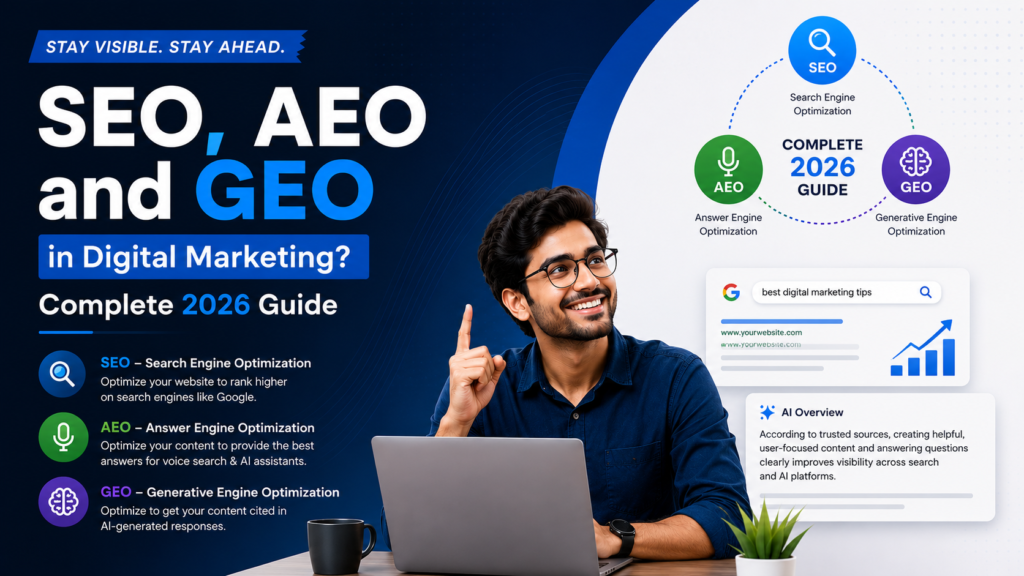
SEO, AEO and GEO are three connected disciplines in digital marketing that help your content get discovered. SEO (Search Engine Optimisation) helps your page rank in traditional Google and Bing search results. AEO (Answer Engine Optimisation) helps your content appear in featured snippets, voice answers, and “People Also Ask” boxes. GEO (Generative Engine Optimisation) helps your brand get cited inside AI-generated answers from ChatGPT, Google AI Overviews, Perplexity, Gemini, and Claude.
Think of it this way. SEO gets you on the page. AEO gets you the answer box. GEO gets you mentioned by the AI. All three are needed because users today move between all three surfaces — sometimes within the same search session.
SEO Explained: The Original Discipline
Search Engine Optimisation is the practice of improving a website so it ranks higher in the organic (non-paid) results of search engines like Google, Bing, and DuckDuckGo. It has been the backbone of digital visibility for over two decades.
The Three Pillars of SEO
- On-page SEO — Keyword research, title tags, meta descriptions, header structure, internal linking, and content quality on each individual page.
- Off-page SEO — Backlinks from other websites, brand mentions, digital PR, and social signals that establish authority.
- Technical SEO — Site speed, mobile-friendliness, crawlability, indexation, structured data, and Core Web Vitals.
How SEO Works in 2026
Google still uses crawlers to discover pages, an index to store them, and ranking algorithms — now heavily powered by machine learning systems like RankBrain and MUM — to decide which page deserves position one for a given query. The key ranking factors in 2026 remain: content relevance, E-E-A-T (Experience, Expertise, Authoritativeness, Trustworthiness), backlinks from reputable sites, page experience, and search intent match.
SEO is still the largest source of organic traffic for most websites. Google processes over 8.5 billion searches per day, and roughly 53% of all trackable website traffic still comes from organic search. Ignoring SEO is not an option — even in the age of AI. If you are new to the field, our guide on SEO interview terminologies every fresher must know is a useful primer.
AEO Explained: Optimising for Answers, Not Links
Answer Engine Optimisation is the practice of structuring your content so search engines and voice assistants can extract a direct, concise answer from it. Where SEO wants a click, AEO wants to be the answer — the snippet that appears before anyone scrolls.
AEO became important the moment Google started showing featured snippets, “People Also Ask” boxes, and knowledge panels above the regular blue links. It became urgent when voice assistants like Alexa, Siri, and Google Assistant began reading one single answer aloud instead of listing ten results.
What AEO Optimises For
- Featured snippets at position zero in Google
- “People Also Ask” expandable boxes
- Voice search responses on smart speakers and phones
- Knowledge panels and direct answer cards
- FAQ-rich results that take up extra real estate on SERPs
Core AEO Techniques
- Answer the question in the first 40–60 words of the section. Search engines lift this block almost verbatim into snippets.
- Use clear question-style headings (H2 or H3) that match how people actually search.
- Add FAQ schema markup so Google can render your questions and answers as rich results.
- Write in a conversational tone — voice queries are longer and more natural than typed queries.
- Use structured formats — bullet lists, numbered steps, comparison tables. These get picked up far more often than paragraphs.
AEO is essentially a stricter, more disciplined version of SEO. You are not just trying to rank — you are trying to be the single quotable answer.
GEO Explained: The New Frontier of AI Search
Generative Engine Optimisation is the practice of optimising your content so that generative AI tools — ChatGPT, Google’s AI Overviews, Perplexity, Gemini, Claude, and Microsoft Copilot — cite, reference, or summarise your brand inside their answers.
GEO emerged in late 2023 as ChatGPT crossed 100 million weekly users and Google rolled out AI Overviews (formerly SGE) into mainstream search. By 2025, roughly 60% of Google searches were ending without a single click to any website — a phenomenon called “zero-click search.” If your brand is not inside the AI answer, you do not exist for that query. This is the exact shift we cover in detail in our post on how AI is changing digital marketing careers.
How Generative Engines Choose Sources
Unlike traditional search engines that rank ten links, generative engines synthesise an answer by pulling from multiple sources. They reward content that is:
- Authoritative — clearly written by experts with verifiable credentials and citations
- Structured — easy for an LLM to parse, with clean headings, lists, and definitions
- Factual and current — with specific statistics, dates, names, and data points
- Quotable — short, declarative sentences that can be lifted into an AI summary
- Mentioned across the web — generative engines weigh brand presence on Reddit, Quora, YouTube, LinkedIn, Wikipedia, and news sites heavily
Core GEO Techniques
- Lead with the answer — every section should start with a bold, direct statement an AI can quote.
- Cite primary sources — link to studies, government data, original research. AI models trust cited content more.
- Add specific data points — numbers, percentages, dates, named entities. LLMs love specificity.
- Build off-site presence — get your brand mentioned on Reddit threads, YouTube videos, podcasts, and listicle articles in your niche.
- Use clean semantic HTML — proper heading hierarchy, definition lists, FAQ schema, and Article schema.
- Update content regularly — generative engines prioritise freshness for many query types.
SEO vs AEO vs GEO: Key Differences
The fastest way to understand how these three disciplines differ is to compare them side by side across goals, formats, and surfaces.
| Dimension | SEO | AEO | GEO |
|---|---|---|---|
| Primary Goal | Rank in top 10 links | Be the featured answer | Get cited inside AI answers |
| Surface | Google, Bing SERPs | Snippets, PAA, voice | ChatGPT, AI Overviews, Perplexity |
| Format | Long-form articles, pages | Q&A blocks, lists, tables | Cited summaries, brand mentions |
| Key Signals | Backlinks, E-E-A-T, content depth | Schema, direct answers, structure | Authority, citations, brand mentions |
| Success Metric | Rankings, organic traffic | Snippet captures, voice triggers | AI citation share, brand mentions in LLM answers |
| Click Behaviour | Drives clicks | Mixed — some zero-click | Mostly zero-click, brand exposure |
| Time to Results | 3–9 months | 2–6 months | 2–4 months |
Notice that the three overlap heavily. A well-structured AEO answer is often the exact block of text a generative engine cites. Strong SEO authority signals (backlinks, brand mentions) are also what make a domain trustworthy enough to be quoted by ChatGPT or Perplexity. Optimising for one usually lifts all three — but only if you do it deliberately.
Why You Need All Three in 2026
Some marketers will tell you SEO is dead and only GEO matters. Others will say AI search is a fad and SEO is enough. Both are wrong. The user journey in 2026 looks like this:
- A user asks ChatGPT for the best digital marketing course in Mysore. (GEO surface)
- ChatGPT mentions three institutes, including yours. The user clicks through to verify.
- The user searches Google for your institute’s name. Google shows a featured snippet of your fee structure. (AEO surface)
- The user clicks your website, browses your course pages, and reads two blog posts. (SEO surface)
- They fill in the lead form.
Remove any one of those three surfaces and the lead is lost. SEO drives the deep traffic. AEO captures the high-intent quick answers. GEO ensures your brand is even in the consideration set when someone asks an AI. Treat them as three layers of the same strategy, not three competing tactics. This is also why business owners need to learn digital marketing themselves — outsourcing without understanding leaves you blind to which layer is leaking leads.
How to Optimise for SEO, AEO and GEO Together
The good news: you do not need three separate content strategies. You need one well-engineered piece of content that satisfies all three. Here is the practical workflow we teach at ETMark Academy.
Step 1: Pick a Real Question, Not a Keyword
Instead of targeting “digital marketing course,” target “Which digital marketing course is best for working professionals in India?” Real questions match how people search on Google, ask Alexa, and prompt ChatGPT. One question can rank in all three surfaces.
Step 2: Write a Direct Answer in the First 50 Words
Open every page and every major section with a bolded, complete answer. This single move boosts your chances in featured snippets (AEO) and AI citations (GEO) without hurting SEO at all.
Step 3: Structure Like a Textbook, Not a Blog
Use clear H2 and H3 headings phrased as questions. Add lists, tables, and step-by-step formats. Generative engines parse structured content far better than wall-of-text articles. Search engines reward the same structure with rich snippets.
Step 4: Add Schema Markup
Implement Article, FAQ, HowTo, and Organisation schema. Schema is the cleanest way to tell every kind of search and answer engine what your content means. It is the foundation of both AEO and GEO.
Step 5: Build Brand Mentions Beyond Your Website
Get your brand cited in Reddit threads, Quora answers, YouTube descriptions, podcast show notes, LinkedIn posts, and respected industry blogs. Generative engines pull heavily from these sources when deciding which brands to mention.
Step 6: Track the Right Metrics
- For SEO: rankings, organic traffic, click-through rate, backlinks
- For AEO: featured snippet captures, voice answer triggers, PAA appearances
- For GEO: brand mentions inside ChatGPT, Perplexity, and Google AI Overviews — tracked manually or with tools like Otterly, Profound, and Peec AI
If you are still building your stack, our guide to the top digital marketing tools for beginners covers the SEO and analytics tools you should start with before adding GEO-specific tools.
The Future of Search Belongs to Triple-Optimised Content
The marketers and businesses that will dominate the next five years are not picking sides between SEO, AEO and GEO. They are building content systems that satisfy all three at once — content that ranks on Google, answers on voice, and gets cited by AI.
If you are a business owner, this means rethinking your blog calendar. If you are a marketer, it means upgrading your audit checklist. If you are a student or career switcher, it means learning these three disciplines together — because no employer in 2026 is hiring someone who only knows old-school SEO.
If you want to learn SEO, AEO and GEO with hands-on practice on real projects, explore our AI-ready digital marketing course at ETMark Academy in Mysuru. The curriculum is built around 2026 search realities, not 2018 textbook theory.
Frequently Asked Questions About SEO, AEO and GEO
Is GEO replacing SEO?
No. GEO is adding a new layer on top of SEO, not replacing it. Google still drives the majority of web traffic worldwide, and most generative engines (including ChatGPT and Perplexity) actively pull from Google’s index and rely on the same authority signals that SEO builds. You need SEO as the foundation and GEO as the new visibility layer above it.
What is the difference between AEO and GEO?
AEO optimises for direct answers inside traditional search engines — featured snippets, voice assistants, “People Also Ask” boxes. GEO optimises for being cited inside fully generative answers produced by AI tools like ChatGPT, Gemini, Perplexity, and Google AI Overviews. AEO is about being the answer; GEO is about being one of the sources behind the answer.
Do I need separate tools for SEO, AEO and GEO?
Mostly no. Existing SEO tools like Ahrefs, SEMrush, and Google Search Console cover SEO and most of AEO. For GEO tracking specifically, newer specialised tools like Otterly.AI, Profound, Peec AI, and AthenaHQ track how often your brand appears in ChatGPT and AI Overview answers. One or two GEO-specific tools added to your existing SEO stack is usually enough.
How long does it take to see GEO results?
Typically 2–4 months for a well-optimised website with existing authority. New domains take longer because generative engines weigh domain trust heavily. Start with strong on-page structure, schema markup, and consistent brand mentions across Reddit, Quora, and YouTube to accelerate the timeline.
Should small businesses in India worry about GEO?
Yes — especially local service businesses. When someone in Mysuru asks ChatGPT “best dentist near me” or “good marketing agency in Bangalore,” the AI gives them a shortlist. If your business is not in that shortlist, you have lost the lead before the user even opened Google. Local GEO is one of the highest-ROI moves an Indian SME can make in 2026.
Can I learn SEO, AEO and GEO together?
Yes, and you should. The three disciplines overlap so heavily that learning them separately wastes time. A modern digital marketing course should teach all three as one connected workflow — keyword research, content structure, schema, authority building, and AI citation tracking. ETMark Academy’s AI-ready digital marketing course in Mysore is built around this combined approach.