
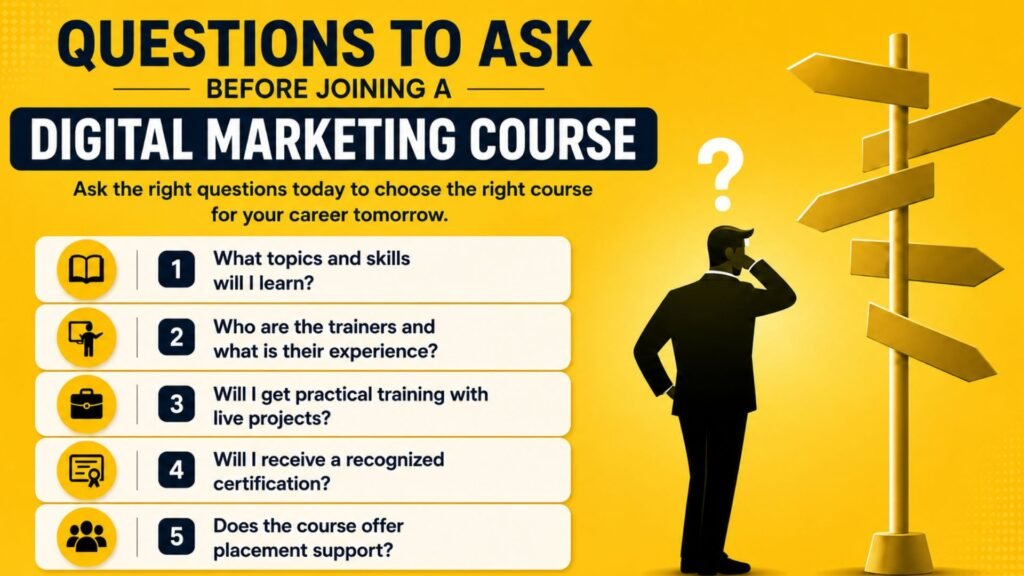
Digital marketing course questions help students, professionals, and business owners choose the right course before investing time and money.
Choosing the wrong digital marketing course is expensive. Not just in money — but in months of your life, and the opportunity cost of starting your career or business growth late.
Every week, students and professionals in cities like Mysuru, Bengaluru, and across India enroll in digital marketing courses without asking the right questions. They finish the program only to discover the curriculum was outdated, the trainer had never run a real campaign, or the “placement support” was just a WhatsApp group with job links.
This guide gives you the exact questions before joining a digital marketing course that help you separate genuine programs from marketing-heavy, results-light ones. Whether you’re a fresher, a working professional, or a business owner, these questions will protect your investment and help you find a course that actually delivers.
Why Asking the Right Questions Before Enrolling Matters
Most digital marketing institutes are good at selling their own courses. They use compelling websites, student testimonials, and attractive placement statistics. But marketing a course and actually delivering one are two very different things.
According to a 2024 industry survey, nearly 43% of students who enrolled in offline digital marketing institutes reported that the course content was either outdated or did not match the syllabus they were shown during the sales pitch.
When you walk into a demo class or speak to a counsellor, you are in a sales conversation — not an academic one. The questions you ask shift the power back to you and reveal what the institute is actually capable of delivering.
15 Critical Questions to Ask Before Joining a Digital Marketing Course
1. What Is the Exact Course Curriculum and Which Topics Are Covered?
This is the single most important question. Ask for the full syllabus — not a brochure summary. A strong digital marketing course in 2025 must cover:
- Search Engine Optimisation (SEO) including technical SEO, on-page, and off-page
- Google Ads (Search, Display, Shopping, YouTube)
- Meta Ads (Facebook and Instagram advertising)
- Social Media Marketing and content strategy
- Email marketing and marketing automation
- Google Analytics 4 and Search Console
- Content marketing and copywriting
- AI tools in digital marketing (ChatGPT, Gemini, automation workflows)
If any of these are missing or are covered in a single 2-hour session, that is a red flag. Digital marketing has become a broad discipline. Surface-level coverage of major topics leaves you unqualified for real jobs or real business applications.
What to listen for: Vague answers like “we cover everything” without specifics, or syllabi that haven’t been updated since 2022.
2. Are the Trainers Active Practitioners or Only Theoretical Educators?
A trainer who has never run a paid campaign, never managed a client’s SEO, or never built a content funnel is teaching from theory — not experience. In a field that changes monthly, that gap is enormous.
Ask: “Can you share the trainer’s professional background and what clients or campaigns they have worked on?”
Look for trainers who currently consult, run their own digital businesses, or actively manage client accounts. Instructors with real-world experience bring current insights, not textbook answers.
3. What Is the Live Practice and Hands-On Component?
Digital marketing is a skill, not just knowledge. You cannot learn Google Ads by watching slides. You learn it by creating campaigns, making mistakes on real budgets, and analysing real data.
Ask specifically: “Do students get to work on live campaigns? Is there a dedicated lab or tool access period?”
Strong programs provide live campaign simulations or actual ad budget practice, tool access to Google Analytics 4, SEMrush, Ahrefs, Meta Ads Manager, and project work where you manage a mock or real business account. Courses that only offer video lectures and MCQ tests are not preparing you for employment or independent execution.
4. Which Tools Will I Learn During the Course?
An employer hiring a digital marketer expects you to already know the tools. Essential tools a quality course should cover include:
- SEO tools: Google Search Console, Ahrefs or SEMrush, Screaming Frog
- Ads platforms: Google Ads Manager, Meta Ads Manager
- Analytics: Google Analytics 4, Looker Studio
- Content tools: Canva, SurferSEO or Yoast, ChatGPT for content workflows
- Email & automation: Mailchimp, HubSpot (basics)
5. Is the Course Curriculum Updated for 2025 Trends?
Digital marketing evolves faster than almost any other industry. AI search, GEO (Generative Engine Optimisation), zero-click results, short-form video, and performance max campaigns are now core topics — not “advanced modules for later.”
Ask: “When was the curriculum last updated? Does it include AI in digital marketing, GA4, and current Google and Meta algorithm changes?”
A course that still teaches Universal Analytics (which Google permanently shut down in 2024), or doesn’t address AI tools in content and search strategy, is already behind.
6. What Are the Course Duration and Time Commitment Requirements?
A thorough digital marketing course typically ranges from 3 to 6 months for a comprehensive classroom program. Anything significantly shorter is likely superficial. Ask about total hours of instruction, frequency of classes, and time commitment outside class for assignments and projects.
7. What Certifications Will I Receive at the End?
There are two types of certifications: institute certificates (issued by the training provider) and industry certifications (issued by Google, Meta, HubSpot, SEMrush Academy). Industry certifications carry weight with employers. A good course should prepare you to clear Google Ads certifications, Google Analytics certification, HubSpot content marketing certification, and Meta Blueprint.
8. What Placement or Career Support Is Provided?
“100% placement” is one of the most overused and under-delivered promises in the Indian training industry. Ask specifically: “How many students from the last two batches got placed? In what roles and companies? What is the average salary package?”
Genuine placement support includes mock interview sessions, resume review, LinkedIn profile building, and direct referrals to hiring partners.
9. What Is the Batch Size and Student-to-Trainer Ratio?
A batch of 50 students with one trainer means limited individual feedback. Small batch sizes (15–25 students) enable more personalised doubt-clearing, better peer learning, and direct access to the trainer for assignment feedback.
10. Is the Course Taught Online, Offline, or Hybrid?
For students who want genuine industry mentorship and real-time feedback, offline or live online courses typically outperform pre-recorded programs. A practical digital marketing course in Mysore with physical lab sessions and live trainer interaction offers an advantage that recorded content cannot replicate.
11. Are There Real-World Projects or Client Work Included?
Projects on your resume matter more than certifications in most hiring decisions. Ask whether the course includes SEO audits on real websites, running ad campaigns for mock or actual clients, content strategy plans, and analytics reporting from actual Google Analytics accounts.
12. What Is the Total Fee Structure? Are There Hidden Costs?
Many institutes advertise a base fee but charge additionally for exam fees, tool subscriptions, study materials, and extended placement support. Ask for a complete fee breakup in writing before you commit — along with refund policies.
13. Can I Speak With or Connect With Past Students?
Any institute confident in its outcomes will connect you with alumni. Ask: “Can I speak directly with a student from your last batch before I enrol?” Real conversations with past students reveal what the course experience is actually like — not the polished version on the sales page.
14. What Makes This Course Different From Free Platforms Like Google Skillshop or HubSpot Academy?
A paid program must justify its cost with live interaction and mentorship, doubt-clearing in real time, networking with peers and industry professionals, accountability, and regional career connections — especially important for learners in Tier 2 cities like Mysuru. If the institute cannot articulate clearly why their program is worth the investment, you deserve a better answer.
15. What Is the Institute’s Own Digital Marketing Presence Like?
This is the most underrated question on this list. Check whether the institute ranks on Google for relevant terms in your city, whether their social media content is consistent and educational, and whether their trainers are active on LinkedIn. An institute that teaches SEO should be visible through SEO. An institute that teaches content marketing should have great content.
Quick Checklist: Questions to Ask Before Enrolling
- ✅ Is the full syllabus available in writing?
- ✅ What is the trainer’s practical experience?
- ✅ Is there live campaign practice or just theory?
- ✅ Which tools does the course teach hands-on?
- ✅ Has the curriculum been updated in 2024–25?
- ✅ What industry certifications does the course prepare you for?
- ✅ What is the actual placement record (with verifiable data)?
- ✅ What is the batch size?
- ✅ Is the total fee inclusive of all costs?
- ✅ Can I speak with a past student?
Final Thoughts
Investing in a digital marketing course is one of the smartest career moves you can make in 2025 — but only if you choose the right one. The questions before joining a digital marketing course listed in this guide are not meant to intimidate an institute. They are meant to help you identify programs that are genuinely built for learner outcomes, not just enrolment numbers.
Take these questions to your next demo session. A great institute will welcome them. A poor one will struggle to answer them.
If you are looking for a program in Karnataka where you can learn from active industry practitioners, work on real campaigns, and build a portfolio before you graduate — explore the practical digital marketing course in Mysore at ETMark Academy.
Frequently Asked Questions
What are the most important questions to ask before joining a digital marketing course?
The most critical questions cover curriculum depth, trainer experience, hands-on practice, tool access, placement support, and whether the syllabus is updated for current industry trends including AI tools and Google Analytics 4.
How do I know if a digital marketing course is worth the money?
Compare the course against free alternatives like Google Skillshop or HubSpot Academy. A paid program must offer live mentorship, real-world project work, industry certifications, and structured career support to justify its cost.
Is placement guarantee in digital marketing courses real?
Placement guarantees are often conditional and poorly defined. Ask for specific placement data — companies, roles, and salary ranges from recent batches — rather than accepting percentage claims at face value.
How long should a good digital marketing course be?
A comprehensive digital marketing course should be 3 to 6 months long, covering both foundational and advanced modules. Shorter programs may only scratch the surface, while longer programs without structured content may be padding.
Should I choose an offline or online digital marketing course?
For learners who want mentorship, peer interaction, and hands-on lab sessions, offline or live online courses are preferable. Recorded self-paced programs work best as supplements to, not replacements for, live instruction.
What certifications should a digital marketing course help me earn?
Look for courses that prepare you for Google Ads certifications, Google Analytics certification, HubSpot Academy certifications, and Meta Blueprint — all of which are recognised by employers across India and globally.
Do I need a technical background to join a digital marketing course?
No. Digital marketing does not require engineering or programming knowledge. Strong communication skills, analytical thinking, and willingness to learn tools are far more important than a technical degree.
About the Author: Jayateerth Kulkarni (SSM) is the founder of ETMark Academy and Sugar Salt Media, a digital marketing training and agency practice based in Mysuru, Karnataka. With over 700 learners trained across institutions including MS Ramaiah, RV University, and Christ College, he holds certifications from Google, Meta, and HubSpot.