
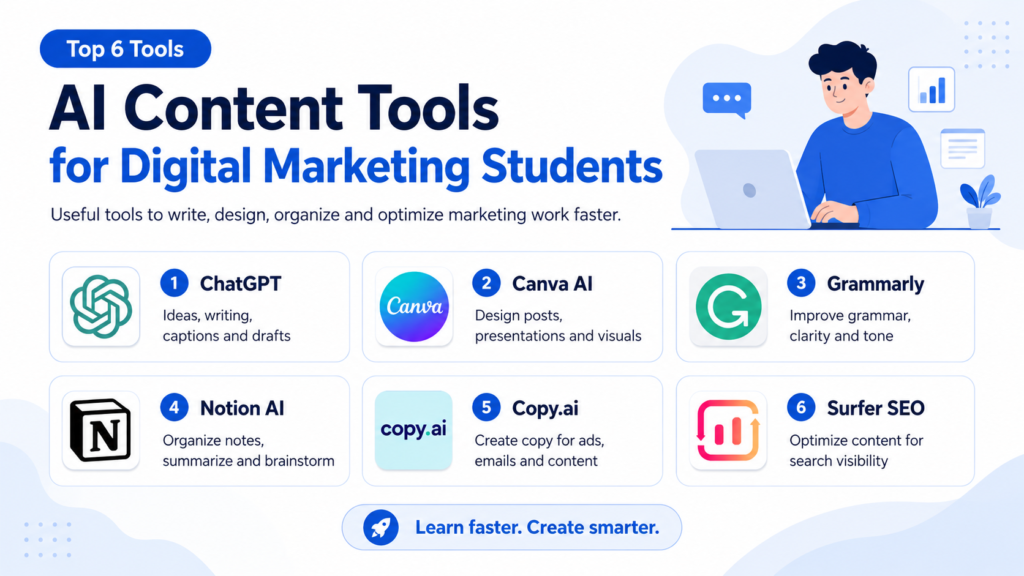
If you are studying digital marketing in 2025, you are entering the field at one of the most exciting and disruptive times in its history. Artificial intelligence has moved from being a buzzword on LinkedIn to being the actual engine behind content creation, SEO research, ad copy, and campaign analytics. The students who learn to use AI content tools today will be the professionals companies compete to hire tomorrow.
This guide covers the most important AI content tools for digital marketing students — what each tool does, why it matters, and how to start using it even before you land your first internship or job.
Why Digital Marketing Students Must Learn AI Content Tools in 2025
The shift is already happening. Marketing agencies, D2C brands, and even small businesses in India are now expecting freshers and interns to arrive with hands-on knowledge of AI tools — not just theoretical awareness. A survey of digital marketing job listings in 2025 shows that over 60% of mid-level roles now mention AI tools, ChatGPT fluency, or prompt engineering as desirable or required skills.
More importantly, AI content tools are not replacing marketers — they are replacing marketers who refuse to use AI. Students who combine creative thinking and strategic judgment with AI execution are becoming 10x contributors in their teams from day one.
The 5 Categories of AI Content Tools Every Student Should Know
AI content tools fall into five broad categories. Each category covers a different part of the content marketing workflow. A well-rounded digital marketing student should have at least one working tool from each category.
1. AI Writing and Copywriting Tools
These tools help you write faster, sharper, and more persuasively. They are the most widely used category of AI content tools in marketing teams today.
- ChatGPT (OpenAI) — The most well-known AI writing assistant. Use it for blog drafts, email copy, social captions, ad scripts, and brainstorming campaign ideas. Students should specifically practice writing high-quality prompts (prompt engineering) to get the best outputs.
- Claude by Anthropic — Particularly strong for longer-form assignments, document analysis, and nuanced brand writing. Great for writing detailed blog posts, case studies, and course assignments.
- Jasper AI — Built specifically for marketing teams. It comes pre-loaded with templates for landing pages, Facebook ads, product descriptions, and email subject lines. Jasper is what you will likely encounter in agency settings.
- Copy.ai and Writesonic — Ideal for short-form content. Use these for generating multiple versions of headlines, meta descriptions, and social copy in seconds.
Skill to develop: Learn to write prompts with context, tone, and structure. The quality of your AI output is only as good as the quality of your input. This is now a core marketing skill.
2. AI SEO and Content Research Tools
Before you write a single word, you need to know what to write about, who is already ranking, and what questions your audience is asking. AI-powered SEO tools make this research process ten times faster and more accurate.
- Surfer SEO — Offers real-time content grading as you write. It tells you the ideal word count, keyword density, heading structure, and even the number of images for any given target keyword. For students, it teaches you what Google actually values — not just what textbooks say.
- Frase.io — Combines research and writing by generating content briefs directly from search data. It shows you the top-ranking pages, the questions they answer, and the topics they cover, then helps you write content that competes.
- Answer The Public — Maps out the exact questions, prepositions, and comparisons people type into search engines around any topic. It is a goldmine for blog post ideas and FAQ sections.
- Semrush AI Writing Assistant — Integrates SEO recommendations directly into your writing workflow, so you are optimizing as you create, not after.
Skill to develop: Understand search intent. AI SEO tools are powerful only when you understand why someone is searching for something — informational, transactional, navigational, or commercial. This judgment is human; the data is AI-powered.
3. AI Social Media Content Tools
Social media is where most digital marketing students begin their practical learning. AI tools in this category help you create, plan, and optimize content for platforms like Instagram, LinkedIn, and YouTube.
- Canva AI (Magic Write + Text to Image) — Canva has integrated AI across its entire platform. Magic Write generates captions, blog intros, and social copy. The AI image generator creates visuals from text descriptions. For students who are not trained designers, this is transformative.
- Predis.ai — Generates complete social posts — visuals and captions together — from a single keyword or product description. Extremely useful when building out content calendars for internship projects or college assignments.
- Lately.ai — Specializes in content repurposing. It takes a long-form piece like a podcast, blog post, or webinar recording and turns it into dozens of social snippets. Students who learn content repurposing workflows will stand out in any content role.
- Buffer AI Assistant — Helps generate post ideas, repurpose content, and write platform-specific captions from within a scheduling tool.
Skill to develop: Platform-specific tone and format. AI tools generate generic output by default. Students who can customize AI-generated social content for each platform’s algorithm and audience style will produce significantly better results.
4. AI Visual and Video Content Tools
Visual storytelling is accelerating in 2025. AI has dramatically lowered the barrier to creating high-quality images, infographics, and short-form videos — formats that dominate digital marketing today.
- MidJourney and DALL·E — Generate unique, high-quality images from text prompts. Use these for blog feature images, ad creatives, and Instagram post visuals. Students who can write effective image prompts have a creative edge over those who rely on stock photography.
- InVideo AI — Turns text scripts into full videos with stock footage, voiceovers, and subtitles. Excellent for creating explainer videos, YouTube content, and Reels scripts brought to life.
- Runway ML — More advanced AI video editing and generation. Used by brands for ad campaigns and visual content at scale.
- Adobe Firefly — Adobe’s AI suite integrated into Photoshop and Illustrator. For students who already know Adobe tools, Firefly dramatically speeds up image editing and asset creation.
Skill to develop: Visual brief writing. The best AI visual output comes from precise, detailed prompts that specify style, mood, composition, and context. This is a learnable skill — and one that bridges the gap between creative direction and execution.
5. AI Analytics and Campaign Intelligence Tools
Content creation is only half the job. Understanding what is working, why it is working, and what to do next requires analytics intelligence. AI tools in this category are what separate junior marketers from strategic ones.
- Google Analytics 4 with AI Insights — GA4 uses machine learning to surface anomalies, predict churn, and identify high-value audience segments automatically. Every digital marketing student should have hands-on GA4 experience.
- HubSpot AI — Used by students in internships to manage marketing automation funnels, track the customer journey, and generate campaign performance summaries. HubSpot’s AI assistant can summarize dashboards and suggest next steps in plain English.
- Tableau with AI — Converts raw campaign data into visual dashboards and graphs. Students who can communicate results clearly — not just collect data — are far more valuable to employers.
- Brandwatch and Sprout Social AI — For social listening and sentiment analysis. These tools use AI to monitor brand mentions, competitor activity, and audience sentiment across platforms.
Skill to develop: Data storytelling. Numbers mean nothing unless they are framed as a story with insight and action. AI analytics tools give you the data; your job as a marketer is to tell the client or team what it means and what to do about it.
A Practical Learning Roadmap for Students
Knowing about tools and actually being able to use them in professional contexts are very different things. Here is a simple roadmap to go from awareness to fluency:
- Week 1–2: Start with ChatGPT. Write 10 different types of marketing content — a blog intro, an Instagram caption, a Google Ad headline, an email subject line, a product description, an FAQ, a LinkedIn post, a Reel script, a landing page headline, and a campaign brief. Compare your prompt quality to your output quality.
- Week 3–4: Move to Canva AI and Predis.ai. Create a 7-day social media content calendar for a hypothetical brand using only AI tools. This is a portfolio piece.
- Week 5–6: Learn Surfer SEO or Frase.io. Research and write one complete, optimized blog post (minimum 1,200 words) on a topic relevant to your niche. This is your first real SEO content piece.
- Week 7–8: Set up Google Analytics 4 on a practice website or use the Google Merchandise Store demo account. Run your first AI-powered insight report.
- Ongoing: Document everything you make. Your AI content portfolio — blog posts, social calendars, ad copy samples, analytics reports — is what gets you hired.
Common Mistakes Students Make with AI Content Tools
AI tools are powerful, but they are not self-correcting. Students who misuse them produce content that is generic, inaccurate, or off-brand. Here are the most common mistakes to avoid:
- Publishing AI output without editing: AI content is a first draft, not a final output. It needs your voice, your examples, and your editing before it is ready for any audience.
- Using AI for facts without verifying: AI tools can hallucinate — generating plausible-sounding but incorrect statistics, dates, or claims. Always fact-check before publishing.
- Ignoring brand tone: Generic AI output sounds like every other brand. Train yourself to customize AI content with specific tone guidelines, vocabulary, and messaging frameworks.
- Over-relying on one tool: Each AI content tool has strengths and blind spots. The best digital marketers mix tools depending on the task — ChatGPT for ideation, Surfer SEO for optimization, Canva AI for visuals.
- Not disclosing AI use when required: Some academic and client contexts require disclosure of AI-assisted work. Know the guidelines for every context you are working in.
How to Build Your AI Content Portfolio Before Your First Job
The fastest way to demonstrate AI content tool proficiency is through a portfolio of real work. You do not need a job to build this — you need a hypothetical brand, a real personal project, or a willing local business that will let you practice on their channels.
Here is what a strong AI content portfolio looks like for a digital marketing fresher in 2025:
- Three SEO-optimized blog posts on different topics, showing keyword targeting and content structure
- A 30-day social media content calendar with AI-generated visuals and captions
- Two Google or Meta ad copy sets showing A/B variations and targeting rationale
- A campaign performance report generated from GA4 or HubSpot, with a summary of insights
- A short Reel or YouTube Short script written with AI assistance, with a brief on audience and hook strategy
If you have all five of these, you are more job-ready than the majority of digital marketing graduates entering the market right now.
The Future of AI Content Tools in Digital Marketing
The tools available today — ChatGPT, Surfer SEO, Canva AI, MidJourney — are the foundation, not the ceiling. The next evolution of AI content tools will be agentic: AI systems that plan, create, publish, monitor, and optimize content autonomously across channels. Students who understand the current generation of tools will adapt far more easily to what comes next.
More importantly, AI content optimization is increasingly being evaluated not just by Google’s traditional ranking signals but by generative AI systems like ChatGPT, Perplexity, and Google’s AI Overviews. This emerging discipline — Generative Engine Optimization (GEO) — requires students to think about content differently: not just for ranking, but for being cited by AI systems as a trusted source.
The marketers who will lead this shift are those who learn both SEO and GEO principles now — during their training — so they are ready to apply them the moment they step into a professional role.
Learn AI Content Marketing with Hands-On Practice in Mysore
Understanding AI tools in theory is very different from using them in real campaigns. At ETMark Academy, the curriculum integrates AI content tools into every practical session — from keyword research and blog writing to social media calendars and ad creative. Students work on live briefs and build portfolio-ready projects using the exact tools employers are asking for in 2025.
If you are in Mysuru and looking for a structured, career-focused way to build these skills, explore the AI digital marketing course in Mysore at ETMark Academy — where AI tools are not an add-on module but the backbone of how marketing is taught and practiced.
Frequently Asked Questions
Which AI content tool is best for beginners in digital marketing?
ChatGPT is the best starting point for most beginners. It is versatile, accessible, and free to start with. Once you are comfortable with prompt writing and content generation in ChatGPT, you can move to more specialized tools like Surfer SEO for optimization or Canva AI for visual content.
Are AI content tools replacing digital marketing jobs?
No — AI content tools are replacing the parts of the job that are repetitive and time-consuming, like generating first drafts, resizing images, or pulling basic reports. The strategic, creative, and client-facing parts of digital marketing require human judgment. Students who use AI as a force multiplier — doing more in less time with better quality — are more employable, not less.
Do I need to pay for AI content tools as a student?
Most leading AI content tools offer free plans or trial periods that are sufficient for learning. ChatGPT, Canva AI, Answer The Public, and Google Analytics 4 all have usable free tiers. As you advance and start working with clients or on serious portfolio projects, upgrading to paid plans becomes worthwhile — but it is not a requirement to get started.
How do AI content tools help with SEO?
AI SEO tools like Surfer SEO and Frase.io analyze the top-ranking content for your target keyword and give you specific, data-backed recommendations on structure, word count, keyword usage, and topic coverage. They reduce the guesswork in on-page optimization significantly and help students produce content that is structured to rank, not just written to publish.
What is the difference between SEO and GEO for content?
SEO (Search Engine Optimization) is the practice of optimizing content to rank on traditional search engines like Google. GEO (Generative Engine Optimization) is the emerging practice of optimizing content to be cited and referenced by AI-powered search systems like ChatGPT, Perplexity AI, and Google’s AI Overviews. In 2025, digital marketing students who understand both disciplines have a significant competitive advantage in the job market.