
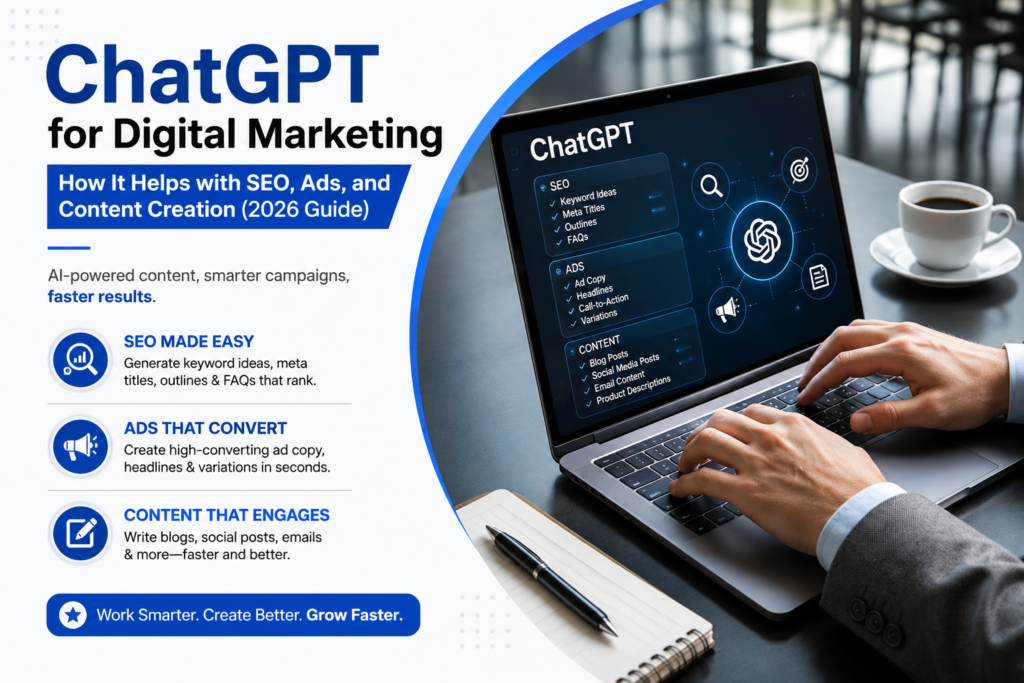
ChatGPT is a large language model developed by OpenAI that generates human-like text based on prompts. Since its public launch, it has become one of the most-used tools in marketing teams worldwide — from solo freelancers to agencies managing multiple clients.
Marketing is a high-volume, high-frequency content operation. You need blog posts, ad copies, social captions, email sequences, and SEO strategies — all at once, all the time. ChatGPT acts as a tireless thinking partner and first-draft writer, compressing hours of work into minutes.
According to a 2024 HubSpot survey, over 74% of marketers reported using AI tools in their content workflows — and ChatGPT was the most commonly cited tool among them.
This guide breaks down exactly how ChatGPT for digital marketing works across three critical areas: SEO, paid advertising, and content creation — with practical use cases and prompt ideas you can start using today.
ChatGPT for SEO: Research, Optimization, and Content Gaps
Search engine optimization involves layers of work — keyword research, competitor analysis, on-page optimization, and content planning. ChatGPT accelerates each of these without replacing the judgment of a seasoned SEO professional.
1. Keyword Research and Topic Clustering
ChatGPT can generate long-tail keyword variations, group them into topic clusters, and help you understand the search intent behind each keyword. While it does not have access to live search volume data, it excels at brainstorming and structuring your keyword universe.
Prompt Example:
“Generate 20 long-tail keyword ideas related to ‘digital marketing for small businesses in India.’ Group them by search intent: informational, navigational, and transactional.”
This single prompt can save two to three hours of manual keyword brainstorming — and the output can be verified in tools like Google Keyword Planner or Ahrefs.
2. SEO Title and Meta Description Writing
Writing compelling meta titles and descriptions at scale is one of the most tedious SEO tasks. ChatGPT can generate multiple variations, respecting character limits and incorporating primary keywords naturally.
Prompt Example:
“Write 5 SEO meta titles and meta descriptions for a blog post about ‘how to run Google Ads for local businesses.’ Keep titles under 60 characters and descriptions under 155 characters.”
3. Content Gap Analysis
By feeding ChatGPT a list of your published topics and competitor content, you can ask it to identify angles you have not yet covered — a powerful way to find blog opportunities quickly without expensive tools.
4. On-Page SEO Review
ChatGPT can audit a draft for keyword placement, heading structure, readability, and internal linking opportunities. Paste your content and ask for a structured SEO review before publishing.
5. FAQ Generation for Featured Snippets
Google frequently surfaces FAQ-style answers in featured snippets and People Also Ask boxes. ChatGPT generates natural, question-based FAQs that increase your chances of capturing position zero on search results pages.
ChatGPT for Ads: Writing High-Converting Ad Copy
Paid advertising demands fast iteration — multiple ad variations for A/B testing, different messages for different audience segments, and copy that earns the click. This is where ChatGPT for digital marketing becomes a genuine productivity multiplier.
1. Google Ads Copy
ChatGPT can write responsive search ad (RSA) headlines and descriptions within Google’s character limits. You can ask for variations around different value propositions — price, speed, trust, and transformation.
Prompt Example:
“Write 10 Google RSA headlines and 4 descriptions for a digital marketing course targeting working professionals in Tier 2 cities. USP: Learn in 3 months, get certified, get placed. Headlines must be under 30 characters.”
2. Meta Ads (Facebook and Instagram)
For Meta ads, the primary text copy is crucial. ChatGPT can generate multiple variants for cold, warm, and retargeting audiences — each with a different emotional hook tailored to where the audience is in their buying journey.
Prompt Example:
“Write 3 Facebook ad primary texts for a digital marketing institute. Audience 1: College students who want to freelance. Audience 2: Working professionals switching careers. Audience 3: Business owners who want to grow online.”
3. Hook Testing
The hook is the first line of your ad and the most tested element in performance marketing. ChatGPT can generate 10 to 20 hook variations from a single brief, giving you a testing bank without creative fatigue.
4. Landing Page Copy Aligned with Ads
Conversion rates improve when ad copy and landing page messaging are tightly aligned. ChatGPT can write hero headlines, subheadlines, benefits, and CTAs that mirror your ad’s promise — reducing bounce rates and increasing conversions.
ChatGPT for Content Creation: Blogs, Social Media, and Email
Content marketing is the backbone of organic growth. For agencies, trainers, and in-house teams, content creation is a never-ending demand. ChatGPT helps maintain content velocity without sacrificing quality — when used correctly.
1. Blog Post Drafting
ChatGPT produces a structured first draft in minutes. The key is giving it a detailed brief: keyword, audience, tone, word count, and required sections. The output is a strong starting point, not a finished article — you still need to add real experience, original data, and brand voice before publishing.
Prompt Example:
“Write a 1,500-word blog post targeting ‘benefits of learning digital marketing in 2025.’ Audience: college students and freshers. Tone: motivating and practical. Include an intro, 5 key benefits, career outcomes, and a CTA.”
2. Social Media Captions and Scripts
From Instagram captions to LinkedIn thought leadership posts to YouTube Shorts scripts, ChatGPT can produce platform-native social content — matching tone, format, and character limits for each channel.
3. Email Marketing Sequences
Email remains one of the highest-ROI marketing channels. ChatGPT can write welcome sequences, nurture flows, promotional campaigns, and re-engagement emails — complete with subject lines and preview text optimised for open rates.
Prompt Example:
“Write a 5-email nurture sequence for leads who downloaded a free guide on digital marketing careers. Move from welcome to overcoming objections to a course enrolment offer.”
4. Content Repurposing
A 2,000-word blog post can become a Twitter thread, an email newsletter, a LinkedIn post, an Instagram carousel, and a YouTube script. ChatGPT handles all of this — paste the source content, specify the format, and review the output.
Real Limitations You Should Know About
No tool is a silver bullet. These are the limitations every marketer using ChatGPT must be aware of:
No real-time data. ChatGPT does not have live access to search volumes, trending topics, or current events unless connected to browsing tools. Always cross-check statistics and market claims independently.
Hallucinations. ChatGPT can confidently produce incorrect information — fake statistics, non-existent studies, wrong attributions. Every factual claim needs verification before publishing.
Generic output without context. Vague briefs produce vague content. The quality of ChatGPT’s output is directly proportional to the quality of your prompt and the context you provide.
Brand voice drift. Without a detailed style guide and examples in your prompt, ChatGPT outputs can sound interchangeable with any other brand. Your voice must be built into every prompt.
Not a strategy replacement. ChatGPT executes tactics efficiently — but it cannot replace strategic thinking, audience empathy, or business judgment. The marketer still leads.
How to Get Started with ChatGPT in Your Marketing Workflow
Week 1 — Experiment with single tasks. Pick one area: meta tag writing, ad copy variations, or blog outlines. Run 10 prompts on the same brief and study what works.
Week 2 — Build your prompt library. Save your best-performing prompts. Treat them as templates. Refine language, context, and constraints over time.
Week 3 — Integrate into workflows. Assign ChatGPT a defined role: first-draft writer, variation generator, or structure builder. Define what human review looks like before any output goes live.
Week 4 — Train your team. Share prompt templates and workflow guidelines. Consistency in how you use AI determines the consistency of output quality.
For those who want structured learning with live mentorship, a digital marketing course with ChatGPT equips you with the hands-on practice to integrate AI tools into real campaigns — from day one.
Frequently Asked Questions
Can ChatGPT replace a digital marketing professional?
No. ChatGPT is a productivity tool, not a replacement for human strategy and judgment. Campaign strategy, audience analysis, and performance interpretation still require experienced marketers.
Is ChatGPT good for SEO?
ChatGPT is useful for SEO writing tasks — meta tag generation, FAQ creation, content briefs, and on-page copy optimization. However, it does not have live search data, so keyword research must be validated in dedicated SEO tools like Ahrefs or Google Search Console.
Which version of ChatGPT is best for marketing?
As of 2025, ChatGPT-4o is the most capable version for marketing tasks. It handles longer context windows, follows detailed instructions better, and produces more nuanced output compared to earlier versions.
How do I avoid generic ChatGPT content?
Context-rich prompting is the answer. Provide your brand voice, target audience, topic angle, examples of preferred outputs, and word constraints. The more context you give, the less generic the output.
Can I use ChatGPT for Google Ads without policy violations?
Yes. ChatGPT can write Google-compliant ad copy when prompted correctly. Ensure the output follows Google’s advertising policies — no misleading claims and accurate business representation.
Where can I learn to use ChatGPT professionally for digital marketing?
A structured digital marketing course with ChatGPT in Mysore covers practical AI workflows for SEO, ads, and content — taught by industry practitioners with live campaign exposure.
Conclusion
ChatGPT for digital marketing is not hype — it is a genuine workflow accelerator when used with intention and skill. Whether you are writing ad copy, optimising content for search, or building email sequences, ChatGPT compresses execution time when guided by a skilled marketer.
The marketers who thrive in 2025 will be those who know exactly how to prompt, evaluate, and deploy AI output in real campaigns. If you are ready to build that skill professionally, a digital marketing course with ChatGPT gives you the structured path to master AI-powered marketing — from fundamentals to live campaign execution.
Written by Jayateerth Kulkarni, Founder — ETMark Academy and Sugar Salt Media. Google, Meta, and HubSpot certified marketer with 700+ learners trained across institutions in Karnataka.