
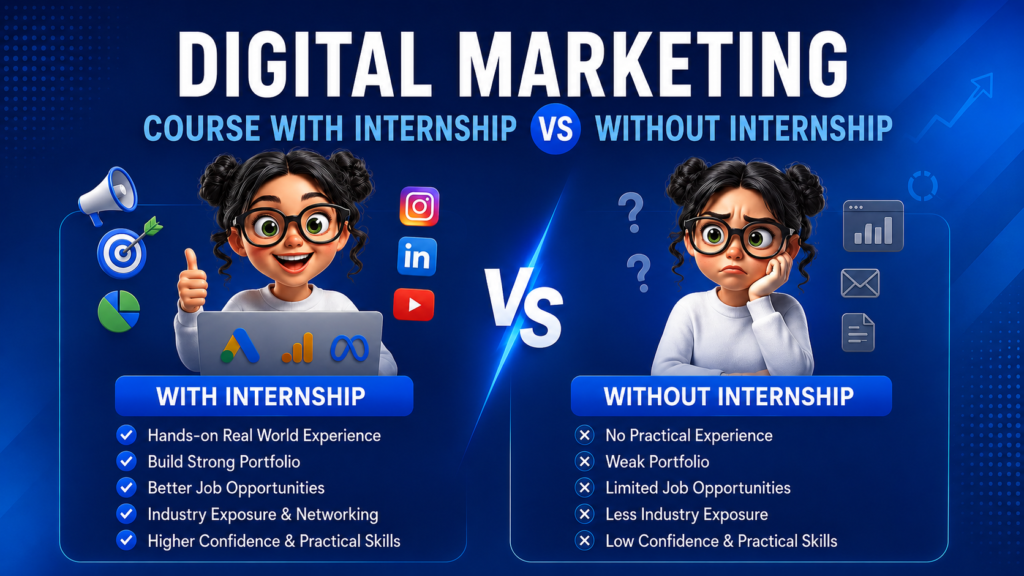
Choosing a digital marketing course with internship can be the difference between graduating with a certificate that sits in a drawer and graduating with live campaign experience that recruiters actually want to see. In a job market where employers in India routinely reject “course-only” candidates for having no proof of real work, the internship component is no longer a bonus — it’s often the deciding factor.
This guide breaks down both paths honestly: what you gain, what you give up, who each option suits best, and how to decide which one fits your goals, budget, and timeline.
Quick Answer: Which Should You Choose?
A digital marketing course with an internship is the better choice for freshers, career-switchers, and anyone who needs portfolio proof before applying for jobs. A course without an internship works well for working professionals who already have access to live projects at their job, business owners learning to market their own brand, or learners on a tight budget who can build a portfolio independently.
If your end goal is employment, prioritise hands-on experience. Skills you can describe in an interview matter far less than work you can actually show.
What Is a Digital Marketing Course With Internship?
A digital marketing course with internship combines structured classroom or online learning with a supervised period of real, applied work. Instead of only watching tutorials and passing quizzes, you run actual campaigns — managing ad budgets, writing content that gets published, analysing live Google Analytics data, and optimising real websites.
The internship can take several forms:
- In-house agency internship: You work on the training institute’s own client accounts under mentor supervision.
- Partner-company placement: The course connects you with a third-party business needing marketing support.
- Live client project: You’re assigned a real local business and deliver work that the client actually uses.
- Simulated capstone with real data: You work on real datasets and real ad accounts, even if the “client” is structured for learning.
The common thread is accountability. Your work has consequences, gets reviewed, and becomes evidence of competence.
What Is a Digital Marketing Course Without Internship?
A course without an internship focuses purely on knowledge transfer. You learn SEO, social media marketing, Google Ads, Meta Ads, email marketing, content writing, and analytics through video lessons, live sessions, assignments, and assessments. You typically finish with a completion certificate and a set of practice exercises.
These courses are usually cheaper, shorter, and more flexible. They suit self-directed learners who are confident they can apply the theory on their own — through freelance gigs, a personal blog, a side project, or their existing job.
The trade-off is simple: you save time and money, but you graduate without a verified body of real-world work.
Side-by-Side Comparison
| Factor | With Internship | Without Internship |
|---|---|---|
| Portfolio at the end | Real campaigns, live results | Practice assignments only |
| Hireability for freshers | High — shows proven experience | Lower — theory without proof |
| Cost | Higher (₹35,000–₹1,20,000+) | Lower (₹5,000–₹40,000) |
| Duration | Longer (4–8 months) | Shorter (1–4 months) |
| Mentorship | Structured, ongoing feedback | Limited or self-guided |
| Flexibility | More fixed schedule | Highly flexible |
| Best for | Freshers, career-switchers | Working pros, business owners, budget learners |
| Confidence on day one of job | High | Variable |
Why the Internship Matters More Than Ever in 2026
According to industry hiring patterns across Indian digital marketing agencies, the most common rejection reason for entry-level candidates is the inability to demonstrate practical execution. A candidate who can say “I managed a ₹50,000 monthly ad budget and lowered cost-per-lead by 22%” beats a candidate who can only list the modules they completed.
There are three concrete reasons hands-on experience wins:
Recruiters trust evidence over certificates. Anyone can finish a course. Far fewer can show a live campaign dashboard, a ranked blog post they wrote, or an ad account they optimised.
The tools change constantly, but applied judgment transfers. Google Ads interfaces, Meta’s ad manager, and SEO best practices shift every year. An intern who has wrestled with real platform changes develops adaptability that a video-only learner doesn’t.
Internships build professional habits. Meeting client deadlines, presenting results, handling feedback, and working within a budget are workplace skills you simply cannot absorb from a tutorial.
When a Course Without Internship Is the Right Call
Skipping the internship is genuinely the smarter choice in specific situations:
- You already have a marketing job and just need to fill skill gaps. Your daily work is your hands-on practice.
- You run a business and want to market it yourself rather than seek employment. You’ll apply everything to your own brand.
- Your budget is genuinely tight and you’re disciplined enough to build a portfolio through freelance platforms or a personal project.
- You’re testing the waters to see whether digital marketing interests you before committing to a longer, costlier program.
In these cases, paying extra for a structured internship adds cost without proportional benefit — provided you have a realistic plan to gain practical experience on your own.
How to Evaluate a Course’s Internship Claim
Many institutes advertise “internship included” but deliver little more than a few mock assignments. Before enrolling, ask these questions:
- Is the work on real, live accounts or simulated exercises?
- Will I get a verifiable internship certificate and a reference I can share with employers?
- Who supervises the work and how often do I get feedback?
- Can I keep the campaigns and results as portfolio pieces?
- What’s the placement or job-support track record of past learners?
A serious program answers these clearly. Vague answers are a red flag.
For learners in Karnataka who want genuine applied experience, a hands-on digital marketing course in Mysore that includes live client work and mentor supervision delivers exactly the kind of portfolio proof that recruiters look for.
Making Your Decision: A Simple Framework
Ask yourself three questions:
- Do I currently have access to real marketing work? If no, lean toward an internship-based course.
- Is my goal a job, or self-application? Jobs reward demonstrable experience; self-application rewards flexible, affordable learning.
- Can I realistically build a portfolio on my own? Be honest. Most beginners overestimate their self-discipline here.
If you answered “no real work,” “I want a job,” and “I’d struggle alone,” the internship path is almost certainly worth the extra investment.
Frequently Asked Questions
Is a digital marketing course with internship worth the extra cost?
For freshers and career-switchers, yes. The internship produces a real portfolio and verifiable experience that directly improves hireability, which usually justifies the higher fee through faster employment and better starting salaries.
Can I get a digital marketing job without an internship?
Yes, but it’s harder. You’ll need to build your own portfolio through freelance work, a personal project, or a side business to prove practical skills, since most employers want evidence of real execution, not just a certificate.
How long does a digital marketing course with internship take?
Most run between four and eight months. The classroom or online learning typically takes one to four months, followed by a supervised internship period of two to four months where you apply skills to real campaigns.
What should I look for in an internship-based course?
Confirm the internship uses real live accounts, provides a verifiable certificate, includes regular mentor feedback, lets you keep your work as portfolio pieces, and has a documented placement track record for past learners.
Does the internship guarantee a job?
No reputable course can guarantee a job, but a strong internship significantly improves your chances by giving you demonstrable experience, professional references, and confidence — the three things entry-level recruiters value most.
Conclusion
The choice between a digital marketing course with internship and one without comes down to a single question: do you need proof of skills, or just the skills themselves? Freshers and job-seekers almost always need proof, which makes the internship path the stronger investment. Working professionals and business owners with their own live projects can often skip it and save both time and money.
Whatever you choose, prioritise applied experience above all else. In digital marketing, what you can show will always outweigh what you can claim.
Ready to gain real, portfolio-ready experience? Explore a hands-on digital marketing course in Mysore that pairs structured learning with live client work.
About the Author
This article was written by the team at ETMark Academy, a Mysuru-based digital marketing and AI training institute that has trained 700+ learners. With visiting faculty experience at institutions including MS Ramaiah, RV University, and Christ College, ETMark Academy specialises in practical, India-contextualised digital marketing education that bridges classroom learning and real-world execution.