
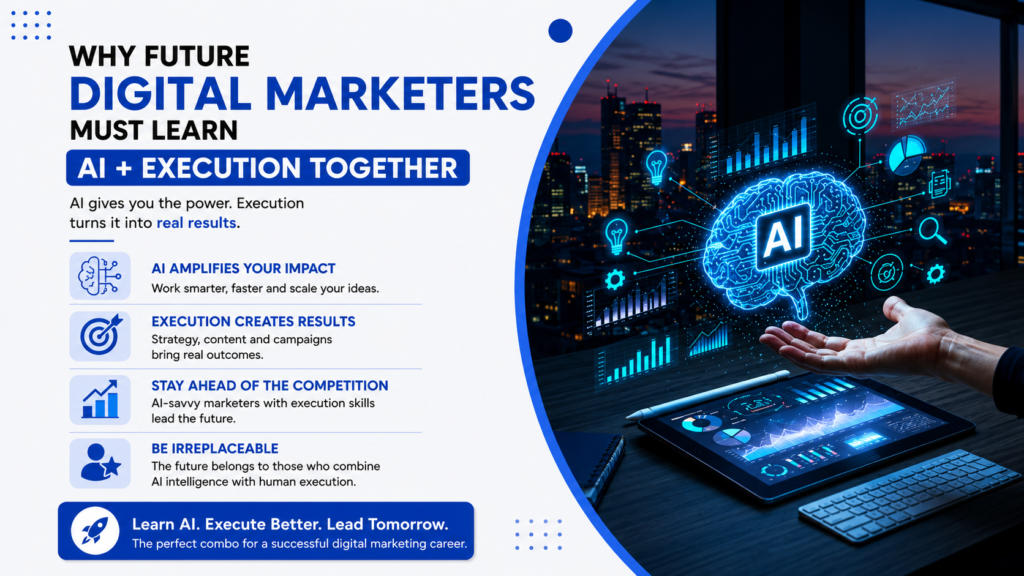
There is a version of a digital marketer who knows every AI tool on the market but cannot write a compelling ad brief. There is another version who can run a flawless Google Ads campaign but freezes when ChatGPT hallucinates a stat. Neither version survives the next five years.
The future belongs to marketers who combine AI and digital marketing skills into a single, unified practice — people who use AI as a force multiplier for real execution, not as a shortcut around it.
This article explains why learning AI in isolation from digital marketing (or marketing without AI) is a career dead end, and what you need to learn instead.
Why AI Alone Is Not a Digital Marketing Skill
Learning to use ChatGPT, Midjourney, or Gemini is not the same as learning digital marketing. These are tools. The same way knowing Photoshop does not make you a designer, knowing how to prompt an AI does not make you a marketer.
What AI tools lack on their own:
- Strategic thinking about audience psychology
- Judgment about what makes a campaign convert
- The ability to interpret performance data and make budget decisions
- Understanding of platform algorithms, ad formats, and buyer journeys
AI augments each of these capabilities. But it cannot replace the underlying skill. A marketer who has never run a real Meta Ads campaign will not know whether an AI-generated ad script is strong or lazy. A student who has never done keyword research will not know if an AI’s content plan targets the right intent.
This is why AI and digital marketing skills must be learned together — not sequentially, not separately, but as an integrated practice.
The Numbers That Should Make Every Marketing Student Pay Attention
The data is unambiguous. According to the American Marketing Association’s 2025 Marketing Skills Report, generative AI is the top-rated future skill, with 43% of marketers predicting it will become more important over the next five years.
But the more urgent finding is this: the largest current competency gaps among marketers are in digital marketing, data and analytics, proving ROI, and data privacy — areas where marketers are not fully equipped to meet the demands of their roles today.
In other words, even as AI adoption accelerates, foundational marketing skills remain underdeveloped. This gap is the opportunity.
The AI in marketing market is valued at $47.32 billion in 2025 and is projected to grow at a CAGR of 36.6% to reach $107.5 billion by 2028. This is not a bubble. It is infrastructure.
More than 80% of marketing teams are actively using generative AI, and 93% of chief marketing officers report a clear return on investment from GenAI. Meanwhile, the number of organizations deploying AI in one or more business functions rose to 88% in 2025, up from 78% in 2024.
The conclusion is clear: companies are not waiting for marketers to catch up. They are hiring people who already know how to work with AI inside real marketing workflows.
What “Execution” Actually Means in Modern Digital Marketing
The word execution gets used loosely. In this context, it means the ability to take a marketing objective from brief to result — including all the decisions, adjustments, and judgments made along the way.
Execution in digital marketing includes:
1. Campaign Strategy and Setup
Understanding what platform suits which objective, how to structure campaigns, and how to set up tracking from day one. AI can suggest a campaign structure. A marketer must evaluate whether that structure makes sense for the budget, the audience, and the goal.
2. Content That Converts
Knowing how to write copy that speaks to a specific buyer at a specific stage of awareness. AI can generate first drafts. A marketer must know what a good hook looks like, what a weak CTA sounds like, and how to edit for emotion and clarity.
3. Reading Performance Data
Looking at a Google Ads dashboard or Meta Ads Manager and knowing which numbers matter. AI can summarize reports. A marketer must interpret the meaning behind a rising CPC or a dropping ROAS and act on it.
4. SEO and Content Architecture
Understanding keyword intent, topical authority, and on-page structure. AI can draft articles. A marketer must ensure the content hierarchy, internal linking, and E-E-A-T signals are solid enough to rank.
5. Channel Coordination
Making content work across search, social, email, and paid channels in a coordinated way. This requires judgment and sequencing that AI tools do not inherently understand.
None of these require you to avoid AI. They require you to use AI with enough grounding to direct it well and catch its errors.
How AI Multiplies Execution When You Have the Foundation
When a marketer with strong fundamentals uses AI, the results compound in every direction.
Manual, time-consuming processes like creating social media posts and analysing data can be handled by AI, freeing humans to focus on strategic insight and creative oversight. This is the correct frame: AI handles volume, the marketer handles judgment.
Here is what that looks like in practice:
| Marketing Task | Without AI | With AI + Skill |
|---|---|---|
| Blog post production | 1 post per week | 4–5 posts per week with quality control |
| Ad copy testing | 2–3 variants manually | 10–15 variants with structured testing |
| Keyword research | Hours of manual analysis | 30-minute deep dive with AI-assisted clustering |
| Email campaign | One draft, one round of edits | Segmented versions tailored per audience |
| Reporting | Raw data to slides manually | Auto-summarised insights, human-verified |
The marketer who knows how to run each of these tasks is the one who can direct AI to do them faster — and catch mistakes before they cost money.
The Risk of Learning AI Without Marketing Fundamentals
This is the pattern emerging in 2025: people completing AI courses, building GPT prompts, and calling themselves “AI marketers” without ever having run a campaign, managed an ad budget, or measured conversion rates.
The problem is not the AI knowledge. The problem is the absence of marketing judgment underneath it.
Marketers identified a lack of skills or training as one of the biggest hurdles in implementing AI, alongside reliability concerns and potential security risks. In other words, even inside organisations, the people using AI often do not have the foundational skills to use it well.
What happens when a marketer without fundamentals uses AI:
- They accept AI-generated strategies without evaluating whether they match audience psychology
- They cannot distinguish a high-converting ad script from a generic one
- They cannot diagnose why a campaign underperformed
- They cannot brief a designer or developer because they lack clear strategic thinking
- They rely on AI to tell them what is working instead of reading the data themselves
AI does not make a weak marketer strong. It makes a strong marketer exceptional.
The Skills Framework: What to Learn, and in What Order
If you are entering digital marketing in 2025 or upgrading your current skill set, here is a practical learning sequence that integrates AI and execution from the beginning.
Layer 1 — Marketing Fundamentals (Non-Negotiable)
- Consumer psychology and buyer journey mapping
- Brand positioning and messaging frameworks
- Campaign goal setting and KPI definition
- Platform literacy: Google, Meta, LinkedIn, YouTube
Layer 2 — Core Digital Execution Skills
- SEO (keyword research, on-page, technical basics)
- Google Ads (Search, Display, Performance Max)
- Meta Ads (campaign structure, audience building, creative testing)
- Content marketing (writing for intent, editing for clarity)
- Email marketing (segmentation, automation, deliverability)
- Analytics (GA4, Search Console, platform dashboards)
Layer 3 — AI Integration Layer
- Prompt engineering for marketing contexts (briefs, copy, analysis)
- AI-assisted content production workflows
- Automated reporting and performance summarisation
- AI tools for SEO: content research, internal linking, schema
- AI tools for paid media: creative testing, audience modelling
- GEO (Generative Engine Optimisation) — making content citation-ready for AI search
Layer 4 — Strategic Overlay
- Testing culture: structuring experiments and reading results
- Campaign optimisation: budget allocation, bid strategy, creative refresh
- Cross-channel coordination
- Data storytelling: turning numbers into actionable client communication
Each layer builds on the one before it. You cannot effectively learn Layer 3 without Layer 2. And Layer 3 without Layer 4 produces technically busy but strategically adrift marketers.
What India’s Marketing Job Market Is Demanding Right Now
The Indian digital economy is expanding at a pace that makes this conversation urgent. Brands across Tier 1 and Tier 2 cities are investing in digital channels at scale, and the talent gap is visible at every level.
According to the World Economic Forum’s Future of Jobs Report 2025, 170 million new roles are projected to be created by 2030 while 92 million are displaced — a net gain of 78 million jobs, concentrated in technology, data, and AI functions. The workers who fill those roles will need hybrid skill sets that combine strategic thinking with working knowledge of AI tools and systems.
In cities like Bengaluru, Mysuru, Pune, and Hyderabad, hiring managers are increasingly filtering for candidates who demonstrate both platform execution experience and AI workflow fluency. A resume that lists “ChatGPT” under skills without accompanying campaign metrics will not land an interview at a growth-focused company.
Conversely, a marketer who can show: “I used AI to produce 20 blog posts in a month, resulting in a 35% increase in organic traffic, validated by GSC data” — that is a hire.
The combination is the competitive advantage.
Why Most Courses Get This Wrong
Most digital marketing courses teach platform skills in silos — one module for SEO, one for ads, one for social. Most AI courses teach prompt engineering in isolation, as if the prompts exist outside any real business context.
The integration is missing. And that integration is precisely where the value is.
At ETMark Academy, the curriculum is designed around this integration. Every module connects the strategic principle, the execution skill, and the AI workflow. Students do not learn ChatGPT prompting as a standalone chapter. They learn it inside the context of writing ad copy, structuring content plans, and analysing campaign data — the actual tasks they will do on the job.
If you are evaluating training options, look for programmes that:
- Teach you how to run campaigns before teaching you how to automate them
- Include live execution practice, not just video content
- Integrate AI tools as workflow enhancements, not as the core product
- Measure learning through outcomes: a campaign run, a content piece ranked, a report delivered
Frequently Asked Questions About AI and Digital Marketing Skills
What is the difference between AI skills and digital marketing skills?
Digital marketing skills refer to the ability to plan, execute, and optimise campaigns across channels like search, social, email, and paid media. AI skills refer to the ability to use artificial intelligence tools to assist, accelerate, and enhance those tasks. The two are most powerful when combined — AI without marketing fundamentals produces low-quality output, and marketing without AI is increasingly slow and uncompetitive.
Do I need to know coding to use AI in digital marketing?
No. Most AI tools used in digital marketing — including ChatGPT, Gemini, Claude, Jasper, and others — require no coding. What you do need is the marketing judgment to direct these tools effectively, evaluate their outputs critically, and integrate them into structured workflows.
Which AI tools should digital marketers learn first?
Start with tools tied to your core tasks: ChatGPT or Claude for copy and strategy, SEMrush or Ahrefs AI features for SEO, Meta’s Advantage+ for paid ads, and GA4’s predictive insights for analytics. Learn each tool in the context of a real task — not as a standalone feature.
Is AI replacing digital marketing jobs?
AI is replacing specific repetitive tasks within marketing roles — not the roles themselves. According to the AMA’s 2025 report, marketers who develop AI proficiency alongside strategic and executional skills will be the most in-demand professionals over the next five years. The risk is not AI replacing marketers. The risk is AI-skilled marketers replacing those without AI skills.
How long does it take to become job-ready in AI-integrated digital marketing?
A structured training programme of 3–6 months covering both foundational marketing skills and AI workflow integration can make a candidate job-ready, especially if the programme includes live execution projects and platform certifications from Google, Meta, and HubSpot.
Can someone from a non-marketing background learn AI and digital marketing?
Absolutely. Many of the strongest digital marketers come from engineering, commerce, media, or arts backgrounds. What matters is logical thinking, curiosity about consumer behaviour, and the willingness to practice on real campaigns. AI tools have made the learning curve shorter — but the fundamentals still take deliberate practice.
Conclusion: The Integrated Marketer Is the Future
The conversation is not “AI vs. digital marketing.” It is “AI and digital marketing, together.”
Marketers who master both will be the ones who ship faster, optimise smarter, and communicate results with clarity. Those who learn only tools without context will hit a ceiling quickly. Those who learn only traditional skills without AI will struggle with pace and volume.
The path forward is integration: deep execution skills supported by intelligent AI workflows, driven by strategic thinking, and measured by real outcomes.
If you are ready to build this integrated skill set, explore the digital marketing course in Mysore at ETMark Academy — designed to teach you how to execute campaigns, use AI tools effectively, and deliver measurable results from day one.