
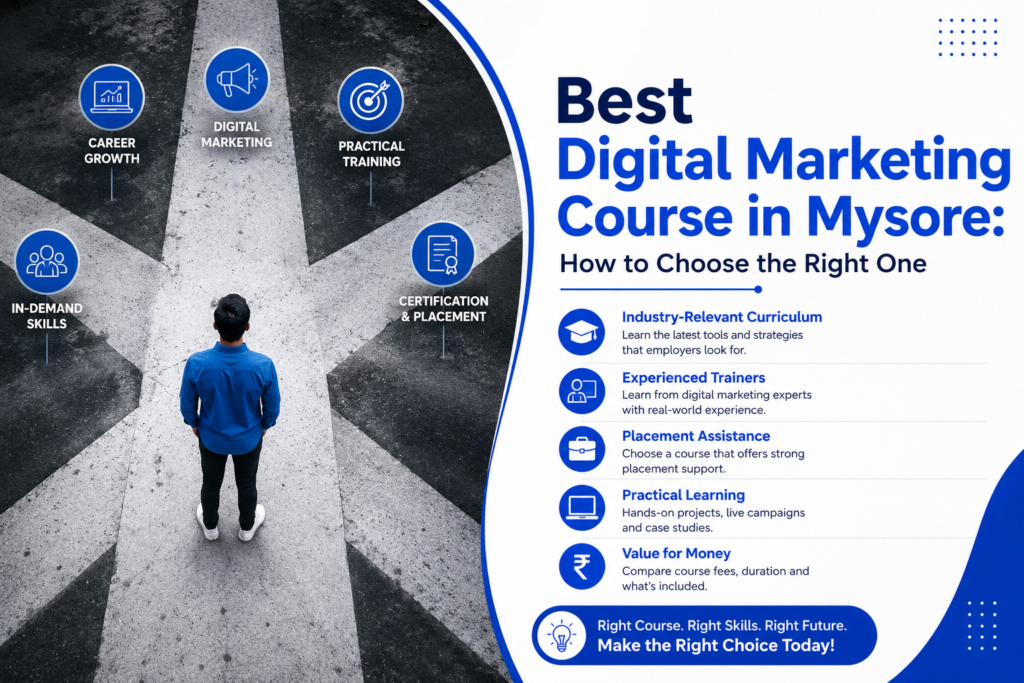
Choosing the best digital marketing course in Mysore is not about picking the course with the biggest poster, lowest fee, or longest list of modules. The right course should help you learn digital marketing practically, build real projects, understand tools, prepare for jobs, and become confident enough to work with businesses.
Many students join digital marketing courses because they hear it has job opportunities. Professionals join because they want to upgrade their careers. Business owners join because they want to understand ads, SEO, social media, and lead generation. But the real problem is this: not every course makes you job-ready.
Some courses only teach definitions.
Some only show recorded videos.
Some focus too much on theory.
Some teach outdated tools.
Some promise placements but do not build practical skills.
That is why you need to know how to choose the right digital marketing course before enrolling.
This guide explains what to check, what to avoid, what modules matter, and how to identify a genuinely practical digital marketing course in Mysore.
What Is a Digital Marketing Course?
A digital marketing course teaches how businesses use online platforms to build visibility, generate leads, attract customers, and grow revenue.
A good course usually covers:
- SEO
- Social media marketing
- Meta Ads
- Google Ads
- Content writing
- Copywriting
- Website basics
- Landing pages
- Email marketing
- WhatsApp marketing
- Analytics
- AI tools
- Lead generation
- Portfolio building
But learning the names of these modules is not enough. A good course should teach how to use these skills in real situations.
For example, it should not only explain what SEO is. It should teach how to do keyword research, write meta titles, optimize blogs, build internal links, and understand Google Search Console.
It should not only explain Meta Ads. It should teach campaign objectives, audience targeting, ad creatives, lead forms, budgets, reporting, and follow-up strategy.
That is the difference between a normal course and a practical course.
Why Choosing the Right Course Matters
Digital marketing is a practical skill. If you learn it only through theory, you may understand terms but still struggle to work on real projects.
A weak course may leave you confused about:
- How to run ads
- How to write content
- How to build a portfolio
- How to do SEO practically
- How to understand analytics
- How to apply for jobs
- How to explain projects in interviews
- How to work with clients or businesses
The right course should reduce confusion and build confidence.
It should help you move from “I know digital marketing terms” to “I can execute digital marketing tasks.”
That is why choosing the best digital marketing course in Mysore should be based on learning quality, not just marketing claims.
Who Should Join a Digital Marketing Course in Mysore?
A digital marketing course is useful for different types of learners.
| Learner Type | Why They Should Learn Digital Marketing |
| Students | To become job-ready, build a portfolio, and get internships |
| Freshers | To enter marketing, content, SEO, ads, or social media roles |
| Working professionals | To upgrade skills or shift careers |
| Business owners | To understand marketing spend, leads, and online growth |
| Freelancers | To get clients and offer digital services |
| Creators | To grow audience and build personal branding |
| Startup founders | To test ideas and generate early traction |
Digital marketing is not limited to IT students or marketing graduates. Commerce, arts, science, engineering, BBA, MBA, design, journalism, and non-IT students can all learn it.
The important thing is not your background. The important thing is whether the course teaches from the basics and gives enough practice.
What Makes a Digital Marketing Course the Best?
The best course is not the one that teaches the maximum number of tools. It is the one that teaches the right skills in the right order with enough practical implementation.
A strong digital marketing course should have:
- Beginner-friendly foundation
- Practical assignments
- Live tool demonstrations
- Real business examples
- SEO implementation
- Paid ads training
- Social media content practice
- Website and landing page understanding
- Analytics and reporting
- AI tool usage
- Portfolio development
- Resume and interview support
- Internship or placement guidance
The course should not make students passive viewers. It should make them active implementers.
1. Check Whether the Course Is Practical or Theory-Based
This is the first and most important point.
A practical course teaches by doing. A theory-based course teaches by explaining.
In digital marketing, explanation is not enough.
You should ask:
- Will I work on live projects?
- Will I create a portfolio?
- Will I practice SEO?
- Will I create ad campaigns?
- Will I write content and copy?
- Will I learn analytics using real dashboards?
- Will I work on website or landing page examples?
- Will I get assignments after each module?
If the answer is no, the course may not make you job-ready.
A good digital marketing course in Mysore should include implementation, not just classroom teaching.
2. Check the Course Modules
A course should cover the major areas of digital marketing. But more importantly, each module should be taught practically.
Here are the essential modules.
SEO
SEO helps websites rank on Google. A good course should teach:
- Keyword research
- Search intent
- On-page SEO
- Technical SEO basics
- Blog optimization
- Internal linking
- Meta titles and descriptions
- Google Search Console
- Local SEO
- Google Business Profile
SEO is important because many businesses want long-term visibility.
Social Media Marketing
Social media is useful for branding, trust, engagement, and community building.
The course should teach:
- Content calendars
- Reels strategy
- Carousel planning
- Caption writing
- Hashtag basics
- Brand storytelling
- Engagement tracking
- Platform-specific content
A good social media module should not only teach posting. It should teach why a post works.
Meta Ads
Meta Ads are used on Facebook, Instagram, Messenger, and WhatsApp.
The course should teach:
- Campaign objectives
- Audience targeting
- Ad sets
- Creatives
- Primary text
- Headlines
- Lead generation ads
- WhatsApp ads
- Retargeting basics
- Budget planning
- Reporting
Meta Ads are important for local businesses, real estate, education, healthcare, events, and e-commerce.
Google Ads
Google Ads helps businesses reach people who are already searching.
A good course should cover:
- Search campaigns
- Keywords
- Match types
- Ad groups
- Headlines
- Descriptions
- Landing pages
- Quality score basics
- Conversion tracking basics
- Campaign reporting
Google Ads is especially useful for lead generation and service businesses.
Content Writing and Copywriting
Digital marketing needs strong writing.
The course should teach:
- Blog writing
- Ad copy
- Captions
- Landing page content
- Email writing
- WhatsApp messages
- Video scripts
- CTA writing
A digital marketer who can write clearly has a major advantage.
Analytics and Reporting
Analytics helps you understand what is working.
The course should teach:
- Google Analytics basics
- Google Search Console
- Meta Ads reporting
- Google Ads reporting
- CTR
- CPC
- CPL
- Conversion rate
- Engagement rate
- Lead tracking
- Report creation
Without analytics, digital marketing becomes guesswork.
AI Tools
Modern digital marketing now includes AI-assisted work.
A good course should teach how to use AI for:
- Content ideas
- Ad copy
- Blog outlines
- Keyword ideas
- Customer personas
- Email drafts
- Campaign reports
- Competitor analysis
- Social media planning
But AI should be taught as a support tool, not as a replacement for thinking.
3. Check Whether the Course Builds a Portfolio
A certificate alone is not enough. A portfolio shows what you can actually do.
By the end of the course, you should have samples like:
- SEO keyword research sheet
- Blog outline
- Optimized blog sample
- Social media calendar
- Caption samples
- Ad copy samples
- Meta Ads campaign plan
- Google Ads campaign plan
- Local SEO audit
- Landing page content
- Basic analytics report
A portfolio helps during interviews because you can show proof of work.
Employers and clients trust practical samples more than only certificates.
4. Check the Trainer’s Experience
The trainer matters a lot.
Before joining, check whether the trainer has real experience in:
- SEO
- Paid ads
- Social media strategy
- Website projects
- Client work
- Content strategy
- Analytics
- Lead generation
- Business marketing
A trainer who has worked on real campaigns can explain practical problems better.
For example, they can explain why ads fail, why leads are poor quality, why SEO takes time, why content needs positioning, and why landing pages affect conversion.
Digital marketing should be taught by someone who has actually done digital marketing.
5. Check Whether the Course Includes Live Projects
Live projects help students understand real business challenges.
A live project may include:
- Promoting a local business
- Creating a content plan
- Auditing a website
- Running a small ad campaign
- Optimizing a Google Business Profile
- Creating a landing page strategy
- Writing blog content
- Preparing a marketing report
Live projects help learners understand how theory becomes execution.
If a course has no projects, students may struggle after completion.
6. Check Placement and Career Support
A good course should support students beyond teaching modules.
Career support may include:
- Resume preparation
- LinkedIn profile guidance
- Portfolio building
- Interview preparation
- Internship support
- Job application guidance
- Mock interviews
- Freelancing guidance
Freshers often need help presenting themselves. They may know the basics but fail to explain their skills properly in interviews.
A course that includes career support becomes more useful.
7. Check Whether the Course Teaches Local Business Marketing
For learners in Mysore, local business marketing is very important.
Many businesses in Mysore need digital marketing, including:
- Colleges
- Coaching centers
- Clinics
- Cafés
- Bakeries
- Boutiques
- Real estate firms
- Interior designers
- Hotels
- Tourism businesses
- Wellness centers
- Salons
- Local service providers
A good course should teach how digital marketing works for local businesses, not just big brands.
Local SEO, Google Business Profile, WhatsApp marketing, Meta lead ads, and location-based content are very important for Mysore businesses.
Digital Marketing Course Comparison Checklist
Use this checklist before choosing a course.
| What to Check | Why It Matters |
| Practical training | Helps you execute real tasks |
| Live projects | Builds confidence and portfolio |
| SEO module | Important for Google visibility |
| Meta Ads module | Important for lead generation |
| Google Ads module | Important for search-based leads |
| Content writing | Needed for ads, blogs, captions, websites |
| Analytics | Helps measure performance |
| AI tools | Improves productivity |
| Portfolio support | Helps in interviews |
| Career guidance | Helps with jobs and internships |
| Trainer experience | Improves learning quality |
| Local business examples | Useful for Mysore market |
If a course covers most of these properly, it is likely to be more useful.
Red Flags to Avoid While Choosing a Course
Not every course is worth your time and money. Avoid courses that show these warning signs.
Red Flag 1: Only Recorded Videos
Recorded videos can support learning, but they should not be the only method. Digital marketing needs interaction, feedback, and practice.
Red Flag 2: No Practical Assignments
If there are no assignments, students may not apply what they learn.
Red Flag 3: Outdated Syllabus
Digital marketing changes quickly. A course should include current tools, AI workflows, analytics, ads, SEO updates, and modern content formats.
Red Flag 4: No Portfolio Building
Without portfolio work, students may struggle to prove their skills.
Red Flag 5: Too Many Promises
Be careful with courses that promise guaranteed high salaries without explaining the learning process, projects, or skill-building method.
Red Flag 6: No Trainer Credibility
A course is only as strong as the person or team teaching it.
Red Flag 7: No Career Support
Freshers need resume, interview, portfolio, and internship guidance. If this is missing, the course may feel incomplete.
How Long Should a Digital Marketing Course Be?
The ideal duration depends on the course depth.
A short workshop can create awareness.
A 1-month course can teach basics.
A 3-month course can make learners job-ready at a beginner level.
A 4 to 6-month course can provide deeper implementation and stronger portfolio building.
If you are serious about jobs, freelancing, or business growth, choose a course that gives enough time for practice.
Digital marketing cannot be mastered in a few days. You need repeated implementation.
Best Learning Path for Beginners
A beginner should learn digital marketing in this order:
- Marketing fundamentals
- Customer journey
- Website and landing page basics
- Content writing
- Social media marketing
- SEO
- Local SEO
- Meta Ads
- Google Ads
- Analytics
- AI tools
- Portfolio building
- Resume and interview preparation
This order helps learners build clarity step by step.
Jumping directly into ads or analytics without understanding marketing basics can create confusion.
Questions to Ask Before Joining a Digital Marketing Course
Before joining any course, ask these questions:
- Is the course practical or theory-based?
- Will I work on live projects?
- Will I build a portfolio?
- Who is the trainer?
- What tools will I learn?
- Will I learn Meta Ads and Google Ads?
- Will I learn SEO practically?
- Will I get assignments?
- Will I receive career guidance?
- Will I get internship or placement support?
- Will I learn AI tools?
- Will I learn analytics and reporting?
- Will I work on local business examples?
The answers will help you identify whether the course is genuinely useful.
Who Can Join a Digital Marketing Course in Mysore?
A digital marketing course in Mysore is suitable for:
- Final-year students
- Fresh graduates
- BBA students
- MBA students
- Commerce students
- Engineering students
- Arts students
- Non-IT students
- Working professionals
- Freelancers
- Business owners
- Startup founders
- Content creators
- Homemakers restarting careers
Digital marketing is skill-based. Anyone who is willing to practice can learn it.
What Outcome Should You Expect?
After completing a good course, you should be able to:
- Understand digital marketing basics
- Create content plans
- Write captions and ad copy
- Do basic SEO
- Understand Meta Ads
- Understand Google Ads
- Read basic reports
- Use AI tools for marketing
- Build a portfolio
- Apply for internships or entry-level jobs
- Support local business marketing
You should not expect to become a senior strategist immediately. But you should become confident enough to start working, applying, practicing, and improving.
Why Practical Learning Matters More Than Certificates
Certificates are useful, but they are not enough.
A certificate says you attended the course.
A portfolio says you practiced the skill.
Companies and clients want to know what you can do.
That is why the best digital marketing course should help you create practical outputs, not just complete modules.
Your course should help you answer interview questions like:
- What SEO work have you done?
- Can you show a content calendar?
- Have you created ad copy?
- Do you understand Meta Ads?
- Can you read a campaign report?
- Can you explain a landing page?
- What tools have you used?
If you can answer with examples, you become more confident.
Frequently Asked Questions
What is the best digital marketing course in Mysore?
The best digital marketing course in Mysore is one that teaches practical implementation, live projects, SEO, social media, Meta Ads, Google Ads, analytics, AI tools, content writing, portfolio building, and career guidance.
How do I choose the right digital marketing course?
Choose a course based on trainer experience, practical assignments, live projects, updated syllabus, portfolio support, career guidance, and tool-based learning. Do not choose only based on low fees or big promises.
Can beginners join a digital marketing course?
Yes. Beginners can join if the course starts from marketing fundamentals and gradually teaches tools, platforms, content, ads, SEO, and analytics.
Is digital marketing good for students?
Yes. Digital marketing is useful for students because it helps them build practical skills, get internships, create portfolios, and become job-ready before or after graduation.
Is coding required for digital marketing?
No. Coding is not required for beginner-level digital marketing. Basic website understanding is helpful, but students can learn SEO, social media, ads, content, and analytics without coding.
How long does it take to learn digital marketing?
A beginner can understand the basics in 2 to 3 months. To become confident with projects, campaigns, SEO, ads, analytics, and portfolio work, 3 to 6 months of consistent practice is better.
Can I get a job after a digital marketing course?
Yes, if the course includes practical training, portfolio building, tool practice, and interview preparation. Freshers can apply for roles like digital marketing intern, SEO executive, social media executive, content writer, and ads assistant.
What should a digital marketing course include?
A strong course should include SEO, social media marketing, Meta Ads, Google Ads, content writing, copywriting, analytics, AI tools, website basics, landing pages, local SEO, portfolio building, and career support.
The Bottom Line
The best digital marketing course in Mysore is not the one with the most attractive advertisement. It is the one that helps you learn practically, build confidence, create a portfolio, understand tools, and prepare for real opportunities.
Before joining, check the syllabus, trainer experience, projects, tools, assignments, portfolio support, and career guidance.
A good course should teach you how digital marketing works in the real world — not just what the terms mean.
For learners in Karnataka who want practical, project-based learning, ETMark Academy’s digital marketing course in Mysore can be a strong starting point to learn SEO, social media marketing, Meta Ads, Google Ads, content writing, analytics, AI tools, and campaign execution with a job-ready approach.