
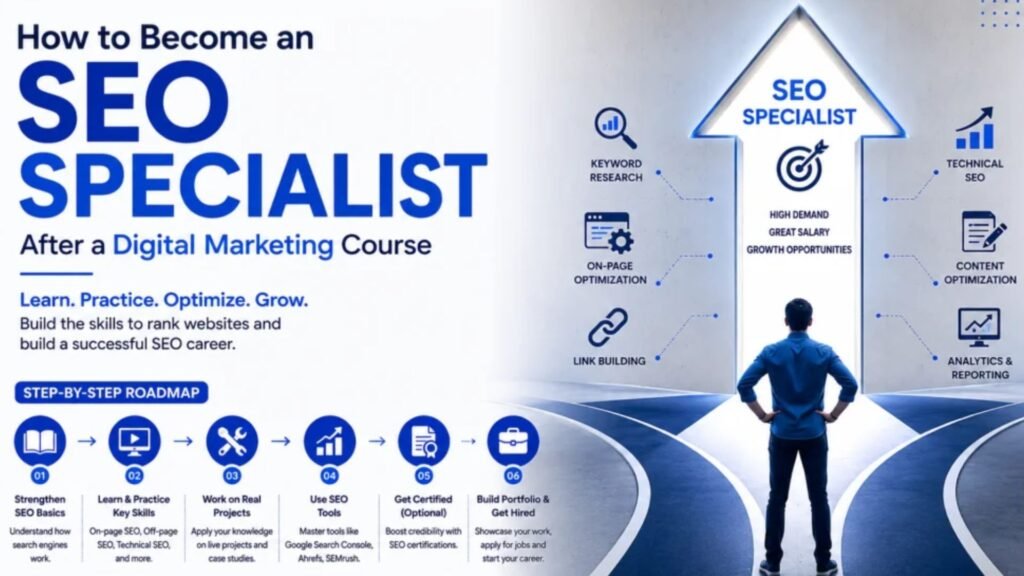
SEO specialist after digital marketing course is a practical career path for students who want to build strong skills in ranking websites, keyword research, content optimization, and analytics.
You’ve just finished a digital marketing course — or you’re close to finishing one — and you want to build a career in SEO. Smart move. Search Engine Optimisation remains one of the most in-demand, high-growth, and versatile skills in the digital economy today.
But a course alone doesn’t make you an SEO specialist. There’s a clear, step-by-step path that bridges the gap between “I know what SEO is” and “I’m getting hired and delivering results.” This guide walks you through exactly that path — from the day you finish your course to the day you land your first SEO role.
What Does an SEO Specialist Actually Do?
Before mapping your career path, it helps to understand the role. An SEO specialist is responsible for improving a website’s visibility on search engines like Google. This involves a mix of technical, creative, and analytical work.
Day-to-day responsibilities typically include:
- Conducting keyword research to identify high-value search terms
- Optimising on-page elements — titles, meta descriptions, headings, and content
- Performing technical SEO audits (site speed, crawlability, schema markup)
- Building or earning backlinks from authoritative websites
- Tracking rankings, organic traffic, and conversions using tools like Google Analytics and Search Console
- Reporting results to clients or internal stakeholders
SEO specialists work in digital agencies, in-house marketing teams, e-commerce brands, media companies, and as freelancers. The role is genuinely cross-functional — you’ll collaborate with content writers, developers, designers, and paid media teams.
Why SEO Is One of the Best Career Paths After a Digital Marketing Course
India’s digital economy is growing rapidly, and SEO is at the centre of it. Almost every business — from local restaurants to national e-commerce brands — needs someone who can make them findable on Google.
Here’s what the career looks like financially in India in 2025:
| Level | Experience | Salary Range (per annum) |
|---|---|---|
| SEO Fresher / Trainee | 0–1 year | ₹1.8 – ₹3 LPA |
| SEO Executive | 1–2 years | ₹3 – ₹4.5 LPA |
| SEO Analyst / Specialist | 2–4 years | ₹4.5 – ₹7.5 LPA |
| SEO Manager | 4–7 years | ₹7.5 – ₹12 LPA |
| SEO Director / Head | 8+ years | ₹15 – ₹30 LPA |
Beyond salary, SEO gives you flexibility. Skilled SEO professionals can freelance, consult, or build their own digital businesses — skills they’ve built are directly monetisable.
Step 1 — Build on Your Digital Marketing Foundation
If you’ve completed a digital marketing course in Mysore or anywhere else, you already have a significant advantage. A good course exposes you to the fundamentals: how search engines work, what keywords are, how content drives rankings, and how analytics tools measure performance.
Now you need to go deeper. The transition from digital marketing generalist to SEO specialist happens when you stop treating SEO as one module among many and start treating it as your primary focus. This means:
- Revisiting every SEO topic from your course with the intent to apply it, not just understand it
- Going beyond basics — understanding crawling, indexing, Core Web Vitals, and search intent at a deeper level
- Reading Google’s own documentation, particularly the Google Search Central documentation
Your digital marketing background is an asset, not just a starting point. Understanding how SEO connects to paid media, content marketing, social media, and conversion optimisation makes you a far more valuable SEO professional than someone who only knows SEO in isolation.
Step 2 — Master the Core SEO Skill Areas
Becoming an SEO specialist means developing competency across four core areas. Most beginners focus on just one or two — make sure you build all four.
1. On-Page SEO
This is where most people start, and it’s the most visible part of SEO. On-page SEO involves optimising everything within your control on a webpage:
- Title tags and meta descriptions (compelling, keyword-rich, within character limits)
- Header hierarchy (H1, H2, H3 usage)
- Content quality and keyword placement (density without stuffing)
- Image optimisation (file size, alt text, descriptive filenames)
- Internal linking structure
- URL structure (short, descriptive, keyword-inclusive)
2. Technical SEO
Technical SEO ensures that search engines can crawl, index, and understand your website correctly. It’s the area that separates intermediate SEO practitioners from true specialists. Core skills include:
- Understanding and fixing crawl errors (using Google Search Console)
- XML sitemaps and robots.txt configuration
- Site speed optimisation and Core Web Vitals (LCP, INP, CLS)
- Mobile-first indexing considerations
- Structured data and schema markup (JSON-LD format)
- Canonical tags and handling duplicate content
- HTTPS and security basics
3. Off-Page SEO and Link Building
Off-page SEO is primarily about building your website’s authority and trustworthiness in the eyes of Google. This is largely driven by backlinks — links from other reputable websites pointing to yours.
Key skills to develop:
- Understanding what makes a backlink valuable (authority, relevance, anchor text)
- Digital PR and content-based link earning
- Guest posting outreach
- Competitor backlink analysis using tools like Ahrefs or Semrush
- Local citations and Google Business Profile optimisation (especially important for local SEO)
4. Keyword Research and Content Strategy
Keyword research is the foundation of every SEO strategy. It’s not just about finding high-volume terms — it’s about understanding search intent and building content that satisfies what users are actually looking for.
- Transactional keywords (used by people ready to buy or act)
- Informational keywords (used by people seeking answers)
- Navigational keywords (used by people looking for a specific brand or site)
- Long-tail keywords (lower volume, lower competition, highly specific)
- Topic clustering — grouping related keywords into content silos
Step 3 — Get Hands-On with the Right SEO Tools
Knowing SEO theory is not enough. Employers and clients want evidence that you can use industry-standard tools to get work done. Here are the tools every aspiring SEO specialist should be comfortable with:
Free Tools (Start Here)
- Google Search Console — Monitor indexing, search performance, Core Web Vitals, and manual actions
- Google Analytics 4 — Understand organic traffic, user behaviour, and conversions
- Google Keyword Planner — Free keyword volume and competition data
- Screaming Frog SEO Spider (free version) — Crawl websites to identify technical issues
- Ubersuggest (free tier) — Keyword ideas, competitor analysis, and site audit
- Google PageSpeed Insights — Measure and diagnose Core Web Vitals issues
Paid Tools (Learn When You Can)
- Ahrefs — Industry-standard for backlink analysis, keyword research, and competitor SEO
- Semrush — Comprehensive SEO suite covering technical audits, position tracking, and content
- Moz Pro — Good for beginners, strong domain authority metrics
Many agencies give you access to paid tools once you’re employed. In the meantime, use free trials strategically and learn the interface of at least one paid tool before interviews.
Step 4 — Build a Personal Website and Practice on It
Nothing will accelerate your learning faster than having your own website to experiment on. This is the most important step that most beginners skip.
Set up a WordPress blog on a topic you’re genuinely interested in. Then apply everything you’re learning — keyword research, on-page optimisation, technical audits, content strategy. Track your rankings weekly using Google Search Console.
Why this works:
- You’re learning by doing, not just watching tutorials
- You have a real example to show in interviews: “I ranked this blog post from position 45 to position 8 in 3 months by doing X”
- You develop an intuition for what works that no course can give you
- You understand the full SEO workflow — from content brief to ranking
Even a modest personal blog that ranks for a few low-competition keywords is worth more in an interview than a stack of certificates.
Step 5 — Get Certified in SEO
Certifications don’t replace experience, but they demonstrate commitment and structured knowledge. These are the certifications that carry weight in the Indian digital marketing industry:
- Google Digital Garage — Fundamentals of Digital Marketing (free, widely recognised)
- HubSpot SEO Certification (free, well-structured, highly respected)
- Semrush SEO Fundamentals Course (free with Semrush Academy)
- Moz SEO Essentials Certificate (paid, thorough)
- Google Analytics 4 Certification (free, from Skillshop — essential for any digital role)
Add all completed certifications to your LinkedIn profile and resume. They signal to hiring managers that you’ve invested time in structured learning beyond your core course.
Step 6 — Build a Portfolio That Demonstrates Results
An SEO portfolio is different from a graphic design portfolio. You’re not showing beautiful work — you’re showing measurable outcomes. Your portfolio should include:
- Case studies — Even from personal projects. “Grew organic traffic from 0 to 500 monthly visitors in 4 months” with screenshots from Search Console is powerful evidence
- Before/after SEO audits — Take a publicly accessible website, perform a technical and on-page audit, document your findings and recommendations. This shows analytical ability even without live client access
- Keyword research samples — Show a complete keyword research document for a hypothetical brief or a real personal project
- Optimised content examples — Blog posts or landing pages you’ve written or optimised, with notes on the strategy behind them
Keep your portfolio in a Google Drive folder or a dedicated page on your personal website. Having it ready before you start applying saves valuable time.
Step 7 — Get Real-World Experience Through Internships or Freelance Work
The fastest way to bridge the gap between training and employment is to work on real websites for real clients — even at low rates or for free in the beginning.
Options to consider:
- Digital agency internships — Many agencies in cities like Mysuru, Bangalore, and Pune offer internships for fresh digital marketing graduates. You’ll work on multiple client websites simultaneously and gain exposure quickly
- Freelance on Fiverr or Upwork — Start with small, low-competition gigs: “I’ll audit your website’s on-page SEO” or “I’ll do keyword research for your blog.” Price them low initially to build reviews
- Help local businesses — Small businesses in your area — restaurants, clinics, coaching centres — often have no SEO at all. Offering to optimise their Google Business Profile and website for free or a nominal fee gives you real experience and a case study
- Volunteer for NGOs or startups — Non-profits often need digital marketing help and can’t afford agencies. This is a genuine way to get hands-on experience while contributing something meaningful
Step 8 — Stay Updated as Google Evolves
Google updates its core algorithm multiple times a year, and smaller updates happen continuously. An SEO specialist who isn’t tracking these changes will quickly find their knowledge outdated.
Build a habit of following these sources:
- Google Search Central Blog — Official announcements about algorithm updates and best practices
- Search Engine Land and Search Engine Journal — Industry news and expert analysis
- Ahrefs Blog and Backlinko — Deep-dive studies and strategy articles
- Twitter/X — Follow SEO practitioners like John Mueller (Google), Barry Schwartz, and Lily Ray
Also pay attention to the rise of AI in search. Google’s AI Overviews (formerly SGE) are changing how SERPs look and how content needs to be structured to earn visibility in AI-generated answers. The concept of GEO (Generative Engine Optimisation) is becoming as important as traditional SEO. Understanding this now puts you ahead of most entry-level candidates.
Career Paths Available to an SEO Specialist
Once you’ve built your foundation, the SEO career path branches in several exciting directions:
- SEO Executive at a Digital Agency — Work on multiple client accounts, develop broad exposure quickly
- In-House SEO Specialist — Join a single brand, go deeper on one website, and own the strategy end-to-end
- Content SEO Specialist — Focus on content strategy, editorial planning, and ranking through high-quality writing
- Technical SEO Specialist — Work closely with development teams on site architecture, crawlability, and performance
- Local SEO Specialist — Help businesses rank for location-based searches, especially valuable for service businesses
- SEO Consultant / Freelancer — Work independently with multiple clients, set your own rates
Over time, SEO specialists often grow into roles like SEO Manager, Head of Organic Growth, or Digital Marketing Manager — positions that carry significant responsibility and compensation.
Common Mistakes Freshers Make When Entering SEO
Knowing what to avoid is as valuable as knowing what to do. Here are the most common mistakes digital marketing graduates make when trying to break into SEO:
- Treating certifications as sufficient — Certificates prove you completed a course. They don’t prove you can rank a website. Always pair certifications with practical work
- Applying for SEO jobs without a portfolio — Hiring managers see dozens of resumes with identical certifications. A portfolio with a real case study makes you instantly stand out
- Keyword stuffing content — This is a common beginner mistake from old-school SEO thinking. Modern SEO rewards content that genuinely satisfies user intent, not content that mechanically repeats a keyword
- Ignoring technical SEO — Most beginners focus only on content and keywords. The candidates who understand technical SEO are far more valuable to employers
- Chasing shortcuts — Black-hat tactics like buying links or using automated content tools might produce short-term results but carry serious long-term penalties. Build your career on white-hat, sustainable practices
How a Digital Marketing Course in Mysore Prepares You for SEO
If you’re in Karnataka and considering a structured path into digital marketing and SEO, the digital marketing course in Mysore at ETMark Academy covers the full spectrum — from SEO fundamentals and keyword research to content strategy, analytics, and AI-powered marketing tools.
What makes a practical, industry-aligned course the right foundation for an SEO career:
- You learn SEO within the context of a complete digital marketing strategy — not in isolation
- Hands-on practice on real tools: Google Search Console, Analytics, keyword research platforms
- Mentorship from practitioners who work in active campaigns — not just academic instructors
- Exposure to how agencies actually structure and deliver SEO work for clients
- A network of peers and alumni who are entering or already working in the industry
The course gives you the framework. This guide gives you the roadmap to take that framework and build a career with it.
Frequently Asked Questions
How long does it take to become an SEO specialist after a digital marketing course?
With focused effort, most people can reach a job-ready level within 3 to 6 months after completing their digital marketing course. This assumes they are actively building a personal website, applying skills, building a portfolio, and pursuing internships or freelance projects during that period. Simply studying without practicing will take much longer.
Is a degree necessary to become an SEO specialist in India?
No. Unlike many traditional careers, SEO hiring is heavily skills-based. Employers and clients care about whether you can rank a website and demonstrate measurable results. A portfolio with real case studies carries far more weight than a degree. That said, a structured course or certification does demonstrate commitment and knowledge.
What is the starting salary for an SEO specialist in India?
Freshers typically start at ₹1.8 to ₹3 LPA (approximately ₹15,000–₹25,000 per month), depending on location, company size, and demonstrated skills. Those with a strong portfolio, practical experience, and the ability to use tools like Ahrefs or Semrush can command salaries at the higher end of this range from day one.
Which is more important — on-page SEO or technical SEO?
Both are essential and work together. On-page SEO ensures your content is relevant and optimised for the right keywords. Technical SEO ensures search engines can actually crawl and index that content. A site with perfect content but technical issues will not rank. A technically sound site with poor content will also struggle. For career purposes, developing technical SEO skills will differentiate you from most entry-level candidates.
Can I do SEO freelance after a digital marketing course?
Yes — and many successful SEO freelancers started exactly this way. The key is to build a portfolio before actively pitching clients. Start with small, affordable projects or help local businesses in exchange for testimonials and case study rights. Once you have 2–3 measurable results to show, freelancing becomes significantly easier.
Does AI affect the demand for SEO specialists?
AI is changing SEO, but it is not replacing SEO specialists. If anything, the rise of AI-powered search (Google’s AI Overviews, Perplexity, ChatGPT search) is creating demand for SEO professionals who understand how to optimise content for both traditional rankings and AI-generated answers — a discipline increasingly called Generative Engine Optimisation (GEO). Specialists who understand both traditional SEO and GEO will be among the most sought-after digital marketing professionals of the next decade.
The Bottom Line
Becoming an SEO specialist after a digital marketing course is entirely achievable — and the path is clearer than most people think. You don’t need another degree. You don’t need years of experience before you can contribute. What you need is a structured approach: deepen your core knowledge, practice on real websites, get certified, build a portfolio that shows results, and get hands-on experience through internships or freelance work.
SEO is a career where the work speaks for itself. A single blog post you’ve ranked, a technical audit that surfaced a critical issue, a keyword strategy that drove organic growth — these are the things that build a career. Start building them today.
About the Author: Jayateerth Kulkarni is the founder of ETMark Academy and Sugar Salt Media. He has trained 700+ learners across Karnataka institutions including MS Ramaiah, RV University, and Christ College, and holds certifications from Google, Meta, and HubSpot. He describes himself as “by chance an engineer, by choice a marketer, by courage a trainer.”